6 books like We by Yevgeny Zamyatin, from 1984 to Brave New World and A Clockwork Orange: the dystopias Zamyatin's banned 1921 novel made possible.
Updated June 10, 2026
Yevgeny Zamyatin's We is the dystopia the famous dystopias copied. Written in 1921 and promptly banned in the Soviet Union (it first appeared in English translation in 1924, decades before it could be published in Russia), it imagines the One State, a glass-walled city of total surveillance where citizens are numbers, not names. The narrator D-503, a mathematician building a spaceship called the Integral, keeps a journal that unravels as he falls for the rebellious I-330 and discovers he has developed the disease of a soul. The book's DNA is everywhere: George Orwell reviewed it in 1946 and wrote 1984 shortly after, openly borrowing its architecture, and Huxley's Brave New World works the same ground whether or not he admitted reading it.
Since We is the source, this list is mostly its descendants, organized by which part of Zamyatin you want more of. For the totalitarian surveillance state and the doomed love affair that cracks it, 1984 is the direct heir. For happiness engineered as a method of control, Brave New World and Fahrenheit 451 follow the thread. For the battle over free will itself, the question of whether an imagination surgically removed or a conscience chemically rewired leaves a person human, A Clockwork Orange is the sharpest companion. The Iron Heel and The Dispossessed bracket the list historically: London's 1908 novel is the rare dystopia older than We, and Le Guin's is the genre grown up enough to question its own utopias.
A note on editions: translation matters with We. The Clarence Brown and Natasha Randall translations are the most commonly recommended modern versions, and Zamyatin's prose is deliberately fragmented, all ellipses and mathematical metaphors, so expect something stranger and more modernist than the smooth realism of Orwell. Most of the books below are easier reads than their ancestor.
Read this if the One State's engineered happiness disturbed you more than its police.
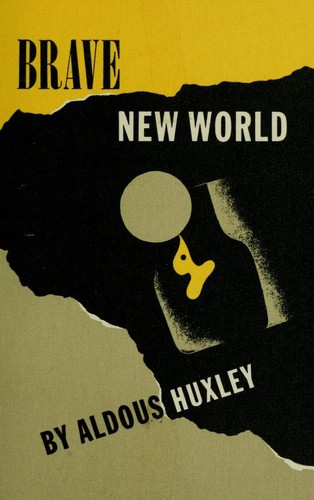
Aldous Huxley's 1932 novel is We's closest intellectual sibling. The World State controls its citizens not primarily through fear but through pleasure: genetic castes decanted in hatcheries, conditioning from infancy, the drug soma, and entertainment engineered to make rebellion unthinkable rather than merely punishable. That is Zamyatin's deepest insight too, that the One State sells unfreedom as happiness, with D-503 genuinely grateful for his scheduled, transparent life until I-330 breaks the spell. Both novels stage the same collision between a managed paradise and an outsider who insists on the right to be unhappy.
Huxley is the smoother read: satirical, witty, and conventionally structured where Zamyatin is feverish and fragmentary. The critique also points in a different direction, at consumerism, mass media, and biotechnology rather than at the collectivist state, which is why Brave New World can feel more contemporary than either We or 1984. Orwell himself thought Huxley must have drawn on Zamyatin; Huxley said he had not read it. Read it and judge the family resemblance yourself.
Read this for the direct descendant, the dystopia Zamyatin's novel made possible.
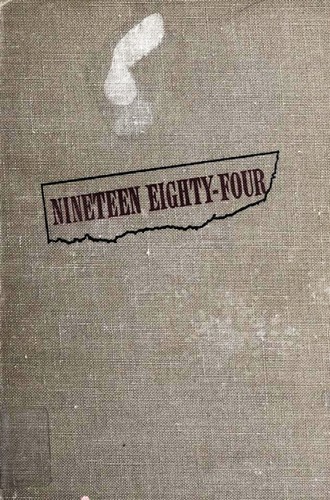
The lineage here is documented, not speculative. Orwell read We in French translation, reviewed it in 1946, and published 1984 three years later with Zamyatin's skeleton intact: a numbered functionary of a total state keeps a forbidden diary, falls into a love affair that doubles as rebellion, contacts an underground resistance, and is broken by the state until he loves his oppressor again. The Benefactor becomes Big Brother, the Guardians become the Thought Police, the Operation that removes imagination becomes Room 101. Reading them back to back is one of the great compare-and-contrast exercises in literature.
What Orwell adds is political flesh. Where Zamyatin's One State is a glass abstraction, a mathematician's nightmare, Orwell's Airstrip One is grimy and specific, with rationed razor blades, falsified archives, and Newspeak's assault on language itself, drawn from his fear of Stalinism. It is bleaker than We and far more famous. If you came to Zamyatin through Orwell, going back showed you the blueprint; if you read We first, 1984 shows you the blueprint built out into the most influential political novel of the century.
Read this if you want the state's war on inner life at its most compressed.
Ray Bradbury's 1953 novel runs Zamyatin's central machinery in an American key. Guy Montag is a fireman who burns books in a society that has chosen wall-sized television and chemical contentment over thought, and like D-503 he is a loyal servant of the system until a strange young woman, Clarisse, asks him whether he is happy. The conversion of a functionary into a fugitive, triggered by one person who notices the world, is the exact arc of We, and both books treat imagination as the contraband the state most needs to destroy.
Bradbury's variation is who does the oppressing: his masses largely censored themselves, abandoning books for entertainment before the firemen ever existed, which makes the novel as much about distraction as dictatorship. It is also the quickest read on this list, a novella-length burst of poetic, pulpy prose. Choose it when you want Zamyatin's themes at speed. Readers who want the full systematic world-building of the One State or Oceania may find it thin; its power is in the velocity.
Read this for the genre grown up, a utopia examined as honestly as Zamyatin examined dystopia.
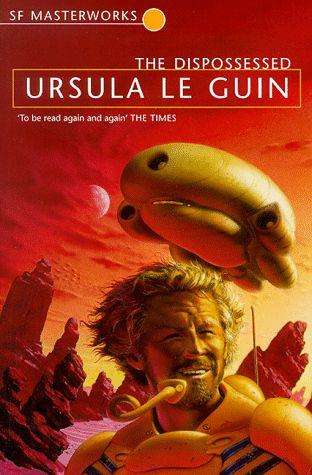
Ursula K. Le Guin's 1974 novel is on this list as the thinking reader's next step. Shevek, a brilliant physicist, travels from Anarres, an anarchist moon settled by revolutionaries, to Urras, the wealthy capitalist world his ancestors fled, and finds walls on both. The kinship with We is structural and real: a scientist protagonist whose work the state wants for its own ends, the question of what individual genius owes the collective, and the discovery that even a society founded on freedom can ossify into conformity enforced by neighbors rather than police.
The difference is that Le Guin is not writing a warning but an investigation; the subtitle is An Ambiguous Utopia, and Anarres is presented with genuine sympathy alongside its failures. There is no Benefactor to defeat, only trade-offs to weigh, and the alternating-timeline structure asks more patience than the propulsive dystopias here. It won both the Hugo and Nebula awards. Pick it when you have had enough of glass cities collapsing and want to think about what should be built instead.
Read this if the Operation at the end of We is the part you cannot stop thinking about.
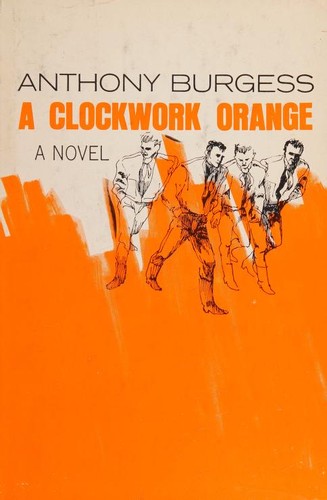
Anthony Burgess's 1962 novel takes the question We ends on, can the state surgically remove what makes a person human, and builds an entire book around it. Alex, a teenage thug who narrates in Nadsat, an invented Russian-inflected slang, is captured and subjected to the Ludovico Technique, conditioning that strips him of the ability to choose violence. The parallel with the One State's Great Operation, which excises imagination to perfect its citizens, is direct, and both novels land on the same argument: a person forced to be good is no longer a person at all, and the cure is worse than the criminal.
Burgess inverts Zamyatin's sympathies, though. D-503 is a gentle conformist crushed by the state; Alex is a genuine monster whose victims are innocent, which makes defending his free will deliberately uncomfortable. The invented slang takes a chapter or two to click, and the violence is graphic in ways Zamyatin never approaches. Note that the famous Kubrick film drops the final chapter of the British edition, where Alex begins to outgrow his cruelty. Read it for the hardest version of the free-will question.
Read this for the dystopia that came before We, with class war at its center.
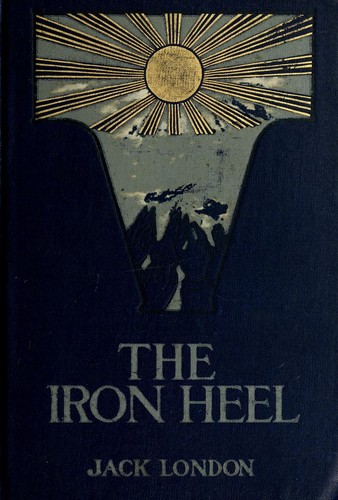
Jack London's 1908 novel is one of the few dystopias Zamyatin could have read rather than inspired, and it shows the genre's other taproot. Presented as a manuscript by Avis Everhard, annotated by a scholar centuries later from a socialist future, it chronicles the rise of the Oligarchy, an American plutocracy that crushes labor movements and democracy with surveillance, mercenaries, and manufactured prosperity for a favored caste. The found-document frame, a firsthand record of tyranny recovered by a later age, anticipates the journal structure of We and the appendix of 1984, and Orwell admired the book's grasp of how oppression actually works.
Be honest about what it is: London stops the action for long stretches of socialist lecture, the hero Ernest Everhard is more mouthpiece than man, and the prophecy is economic rather than psychological, class war rather than the engineering of souls. It reads as a fascinating historical document with stretches of real power, especially the Chicago Commune finale. Choose it if you want to map the dystopia's family tree back past Zamyatin; choose anything else here if you mainly want a gripping novel.
The influence is well documented. Orwell read We in its French translation, published a review of it in Tribune in 1946 praising its intuition about totalitarianism, and recommended it to friends while writing 1984, which appeared in 1949. The structural parallels (the numbered citizen's forbidden diary, the love affair as rebellion, the final breaking of the protagonist) are extensive, though Orwell darkened the ending and grounded the politics in Stalinism.
Should I read We before or after 1984 and Brave New World?
Any order works, but reading We after the famous two is rewarding because you can see what each borrowed. Zamyatin wrote first, in 1921, and his novel is stranger in style, a fragmented journal full of mathematical imagery, than either descendant. If you are starting fresh, 1984 is the most accessible entry point, and We is best read in the Clarence Brown or Natasha Randall translation.
Why was We banned in the Soviet Union?
Its satire of a collectivist state that erases the individual was unmistakably aimed at the direction Soviet society was heading, and the censors treated it that way. We became the first work banned by Goskomizdat, circulated abroad in translation starting in 1924, and was not legally published in the Soviet Union until 1988. Zamyatin himself, after years of official persecution, wrote to Stalin and was permitted to emigrate in 1931, dying in Paris in 1937.
What should I read after We if I have already read the classic dystopias?
From this list, The Dispossessed is the strongest next step, since it interrogates utopia rather than repeating the warning. Beyond the list, Margaret Atwood's The Handmaid's Tale extends the tradition to reproductive control, Kazuo Ishiguro's Never Let Me Go approaches engineered lives obliquely, and Vladimir Sorokin's Day of the Oprichnik returns dystopia to Russian soil with a satire Zamyatin would recognize.
As an Amazon Associate, we earn from qualifying purchases. · About & methodology