9 books like Project Hail Mary, from The Martian to Children of Time and The Three-Body Problem: science-driven space stories for Andy Weir fans.
Updated June 10, 2026
Project Hail Mary works because Andy Weir found a structure that turns problem-solving into plot. Ryland Grace wakes alone on a ship with amnesia, light-years from Earth, and the book alternates between his present (figure out the ship, the mission, and the microbe eating the sun) and recovered memories of how a junior-high science teacher ended up humanity's last hope. Add Rocky, the spider-like engineer alien who communicates in musical chords and becomes one of the great friendships in modern science fiction, and you get a book that is rigorous about physics and openly warm about people. That combination is rare, which is why finding the next one is hard.
This list is sorted by which half of the formula you want more of. For Weir's own voice, The Martian and Artemis are here, one a masterpiece of the survival-by-science genre and one a lighter heist. For the first-contact and big-idea thread, Children of Time, The Three-Body Problem, and Blindsight escalate from wondrous to genuinely unsettling. For the warmth, The Long Way to a Small, Angry Planet keeps the found-family feeling, and The Calculating Stars keeps the competent-scientist-saves-the-world energy. Red Mars and Old Man's War round it out for readers who want rigor or momentum at scale.
A practical note: tone varies more here than science does. The Martian and Old Man's War are as breezy as Weir; Blindsight and The Three-Body Problem are cold and demanding. Every entry below says where it matches Project Hail Mary and where it will surprise you, so pick by mood, not just premise.
Read this if you have somehow not read it already; it is the obvious first stop.
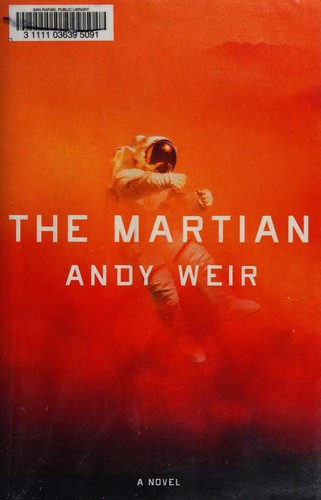
Weir's 2011 debut is Project Hail Mary's direct ancestor and shares almost every part of its DNA: a lone, wisecracking scientist in a lethal environment, surviving through chained engineering problems the book actually shows its work on. Mark Watney, stranded on Mars after his crew evacuates, grows potatoes in his own waste, repurposes rover parts, and narrates it all in log entries with the same gallows humor Ryland Grace runs on. If duct-tape-and-orbital-mechanics competence is what you loved, this is the purest dose of it ever written.
What it lacks, by design, is everything Project Hail Mary added later: there are no aliens, no first contact, no Rocky, and the emotional register stays lighter because Watney is never asked to carry the species, just himself. Some readers find Watney's relentless jokes thinner than Grace's arc. It remains the better-constructed survival story of the two, and the Ridley Scott film is faithful, but read the book first for the math.
Read this only if you want Weir's voice and accept a smaller story.
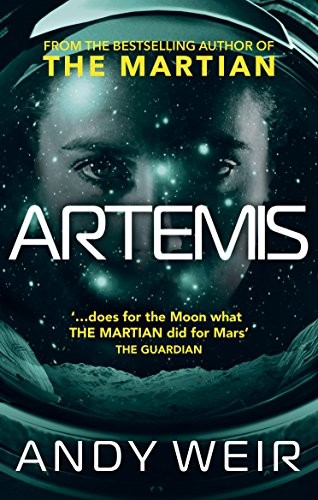
Artemis, Weir's 2017 second novel, applies his trademark to a different genre: it is a heist caper set in the first city on the Moon, narrated by Jazz Bashara, a porter and small-time smuggler who takes a sabotage job that spirals into a fight over who controls the city. The lunar engineering is classic Weir, welding in vacuum, aluminum smelting, airlock physics, all load-bearing for the plot, and the snappy first-person narration will feel immediately familiar to anyone who liked Grace and Watney.
It is also widely regarded as his weakest book, and going in knowing that helps. The stakes are local rather than existential, there is nothing like Rocky, and Jazz's voice (Weir writing a young Saudi woman with the same jokey register as his other narrators) did not land for many readers. The caper itself is fun and fast. Pick it as a light snack between bigger books, with expectations set to entertaining rather than essential.
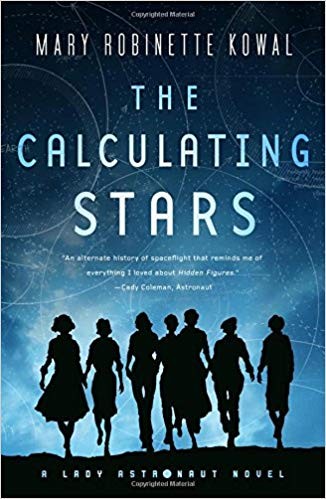
Read this if you loved competent scientists racing an extinction deadline.
Mary Robinette Kowal's Hugo and Nebula winner shares Project Hail Mary's exact engine: an incoming planetary catastrophe forces a crash international space program, and the story follows the competent, likable scientist at its center. In 1952, a meteorite obliterates Washington, D.C., and the resulting climate runaway means humanity must get off Earth within decades. Elma York, a mathematician and former WASP pilot, calculates the threat and then fights to become one of the first astronauts. The math is real, the alternate-history space program is lovingly detailed, and the tone stays fundamentally hopeful.
The difference is what the obstacles are. Elma's enemies are not airlocks and alien microbes but sexism, racism, and her own anxiety disorder; the book spends as much time in press conferences and cockpit politics as in orbit. There is no alien contact at all. Choose it if the save-the-world institutional effort (the parts of Project Hail Mary with Stratt assembling the mission) appealed as much as the spaceship scenes.
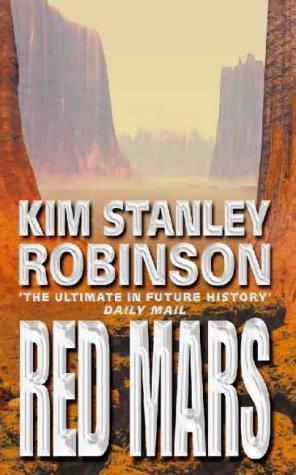
Read this if you want the science taken seriously at ten times the scale.
Kim Stanley Robinson's 1992 classic is where you go when Weir's rigor is the attraction and you want it applied to something vast. Red Mars follows the first hundred colonists from landing through the early terraforming of Mars across decades, and the science (areology, ecology, orbital mechanics, the space elevator) is researched to a depth no other novel on this list attempts. If you finished Project Hail Mary wishing the engineering passages were longer, this is the only book here that will call your bluff.
Be honest with yourself about what it is not: fast, funny, or centered on one charming narrator. Robinson's cast is large and often abrasive, the politics of revolution and corporate control get as many pages as the science, and the pace is geological by design. It opens with a murder and then jumps back, but momentum is not the point; immersion is. Commit if you want a world, not a ride, and know two more volumes (Green Mars, Blue Mars) wait beyond it.
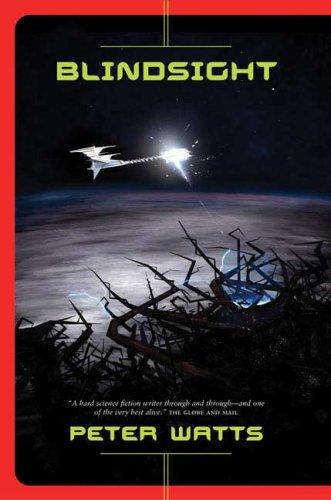
Read this only if you want first contact stripped of all comfort.
Peter Watts's 2006 novel is the anti-Project Hail Mary in the most interesting way: it takes the same setup, a crew sent to investigate an alien presence that may decide humanity's fate, and asks what happens if the universe is not friendly and understanding is not possible. The crew of the Theseus, augmented post-humans led by a resurrected vampire (given a startlingly rigorous biological justification), confronts an alien object whose inhabitants challenge the assumption that intelligence requires consciousness at all. The science is as hard as Weir's, arguably harder, with an appendix of citations.
Where Weir gives you Rocky, Watts gives you Rorschach, and the contrast is the point: no friendship, no jazz hands, no warmth, just a brilliant and genuinely disturbing argument about what minds are. It is dense, told by an unreliable narrator who lacks normal empathy, and many readers need two attempts. Read it when you are ready to have Project Hail Mary's optimism interrogated by the smartest pessimist in the genre.
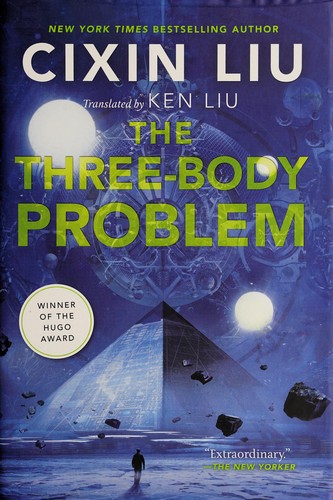
Read this if the science-puzzle side hooked you and you want it at civilizational scale.
Liu Cixin's Hugo winner (translated by Ken Liu) shares Project Hail Mary's deepest pleasure: watching scientists reason their way toward an extraordinary truth. Beginning in the Cultural Revolution and moving to a present where physicists are dying and experiments are returning impossible results, it unfolds as a scientific mystery whose answer involves a first contact with stakes as existential as Weir's Astrophage, and a famous physics-driven setpiece involving a planet with three suns. The ideas, about game theory between civilizations, the limits of physics, and survival, are the biggest on this list.
The trade-off is everything else Weir offers. Characters are vehicles for ideas rather than companions, the humor is nearly absent, and the structure (nested flashbacks, long sequences inside a virtual-reality game) demands patience. There is no Rocky here; the aliens inspire awe and dread, not affection. Pick it when you want your mind stretched rather than your spirits lifted, and know the trilogy darkens further in The Dark Forest.
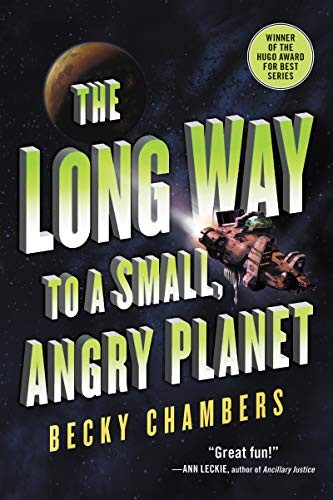
Becky Chambers's debut is the place to go for the half of Project Hail Mary that was a friendship story. The Wayfarer is a worn ship that bores wormhole tunnels through space, and its crew, human and otherwise, takes on a long, risky contract that is mostly an excuse for the reader to live with them. The interspecies relationships are the entire point: alien crewmates with genuinely alien biology, customs, and ways of caring, rendered with the same warmth that made Grace and Rocky's chord-by-chord friendship the best thing in Weir's book.
Know what you are trading away: the plot is episodic and gentle, the science is set dressing rather than load-bearing, and nobody is racing to save a species. Readers who wanted tension and problem-solving sometimes bounce off it as too cozy. Read it like a favorite crew-based TV season, for the people rather than the peril. If the found-family feeling lands, the loosely connected sequels are just as kind.
Read this for the same breezy, funny voice pointed at military SF.
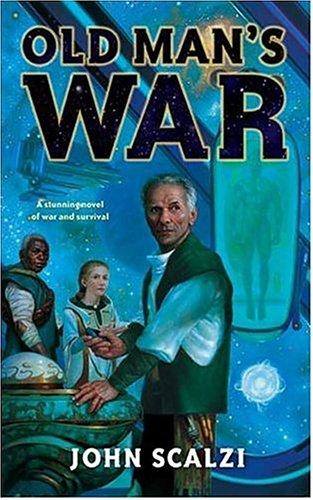
John Scalzi's 2005 debut is the closest match on this list for Weir's narrative voice: plainspoken, fast, and reliably funny in the face of cosmic danger. John Perry enlists in the Colonial Defense Forces on his seventy-fifth birthday, because the CDF recruits the elderly from Earth and gives them new, enhanced bodies to fight a galaxy crowded with hostile species. Like Weir, Scalzi explains his technology cleanly, keeps chapters propulsive, and lets an ordinary, decent narrator carry you through extraordinary events.
The content is a real departure: this is military science fiction, with boot camp, combat, and an essentially hostile universe in place of Weir's lone-scientist problem-solving and interspecies friendship. The aliens here are mostly enemies, sometimes unsettlingly so. Choose it when you want the reading experience of Weir (one more chapter, finished in a weekend) and do not mind swapping the lab for a battlefield. The Heinlein influence is open and acknowledged.
Read this if first contact and an unforgettable nonhuman mind are what you want next.
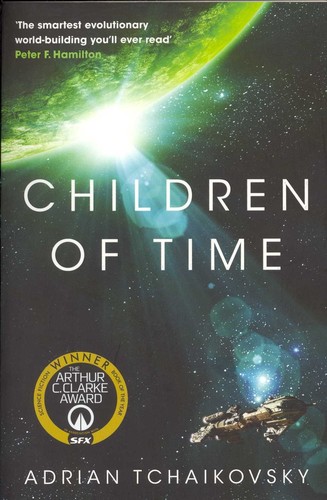
Adrian Tchaikovsky's Arthur C. Clarke Award winner delivers, at evolutionary scale, the thing Project Hail Mary readers most want more of: a nonhuman intelligence you come to love. A terraforming project gone wrong leaves a planet's uplift nanovirus working on spiders instead of monkeys, and the book alternates between their civilization rising across millennia (told through generations of spiders named Portia) and the ark ship of humanity's desperate remnant approaching the same world. Like Weir, Tchaikovsky makes alien biology the star, working out how spider senses, sex politics, and chemistry would shape technology and culture, and the ending lands as one of the genre's great arguments for empathy over fear.
It is a bigger, slower, more structurally ambitious book than Project Hail Mary, spanning thousands of years with no single companionable narrator, and the human chapters are deliberately bleaker than anything in Weir. Arachnophobes should know the spiders are the point, though many report being converted. This is the strongest pure science fiction novel on the list, and its sequels (Children of Ruin, Children of Memory) keep the quality up.
The Martian, Andy Weir's own debut, is the closest match: the same lone-scientist survival structure, the same show-your-work science, and the same jokey narrator. Among other authors, Children of Time by Adrian Tchaikovsky best matches the first-contact wonder and the beloved nonhuman character, while The Martian remains the answer for the problem-solving core.
Is there a sequel to Project Hail Mary?
No sequel has been published. Project Hail Mary (2021) ends conclusively, and Weir has said he prefers standalones; his other novels, The Martian and Artemis, are unrelated stories. A film adaptation starring Ryan Gosling as Ryland Grace, directed by Phil Lord and Christopher Miller, has been in production with a planned 2026 release.
Which of these books has a character like Rocky?
Children of Time comes closest in spirit: its spider civilization, followed through generations, earns the same affection for a genuinely nonhuman mind. The Long Way to a Small, Angry Planet offers several warm alien crewmates rather than one standout friendship. At the other pole, Blindsight deliberately gives you an alien that cannot be befriended, which makes it the most interesting contrast read.
I want the science to be as rigorous as Weir's. Where should I start?
Red Mars is the deepest, with decades of terraforming worked out in researched detail, though it is slow. Blindsight is rigorous about neuroscience and biology and even includes citations. The Calculating Stars keeps its orbital math honest inside a faster story. The Three-Body Problem plays looser in places but builds its plot directly out of physics problems.
As an Amazon Associate, we earn from qualifying purchases. · About & methodology