6 books like The Tao of Pooh, from The Te of Piglet to Siddhartha and The Four Agreements: gentle philosophy and Eastern wisdom made approachable.
Updated June 10, 2026
Benjamin Hoff's The Tao of Pooh, published in 1982, pulled off an odd and durable trick: it taught Taoism through Winnie the Pooh. Hoff's argument is that Pooh, without trying, embodies the Taoist ideal of the Uncarved Block, the natural simplicity that gets things done precisely because it does not strain. Owl's cleverness and Rabbit's busyness come in for gentle mockery, and Hoff's portrait of the Bisy Backson, the perpetually rushing modern achiever, has only gotten more pointed since. The book spent years on bestseller lists and is still many readers' first contact with the idea of wu wei, effortless action.
Readers who want more tend to want one of three things, and this list covers them all. Some want literally more Hoff and the Hundred Acre Wood, which The Te of Piglet provides directly. Some want more Eastern wisdom delivered gently, the lane of Siddhartha, The Art of Happiness, and Zen and the Art of Motorcycle Maintenance, which range from a slim fable to a demanding philosophical road trip. And some want the broader genre of short, warm wisdom books, where The Prophet and The Four Agreements live.
A practical note: most of these are short and forgiving, but they are not interchangeable. The Four Agreements and The Prophet can be read in an evening; Siddhartha asks for a quiet weekend; Zen and the Art of Motorcycle Maintenance is a real commitment that rewards patience. Each pick below says what it shares with Hoff and what it will ask of you.
Read this if you simply want more Hoff and more of the Hundred Acre Wood.
This is Hoff's own 1992 sequel, and it is the only place to get exactly the same formula: Taoist ideas explained through A. A. Milne's characters, with dialogue scenes where Pooh and friends interrupt the author mid-lesson. Where the first book used Pooh to illustrate natural simplicity, this one uses Piglet to explore Te, often translated as virtue, the surprising power of the small. For readers who loved the warmth of watching big ideas walk around in familiar fur, the continuity is real and immediate.
Be honest with yourself about its reputation, though: it is widely considered a step down from The Tao of Pooh. Hoff spends noticeably more time on grumpy digressions about modern society, education, and politics, and the charm-to-lecture ratio suffers for it. The Piglet material is lovely when it arrives; it just arrives less often than you would like. Come to it as a fan wanting more time in this world, with expectations set a notch lower, and it still pays off.
Read this if you want the gentle Eastern wisdom carried by an actual story.
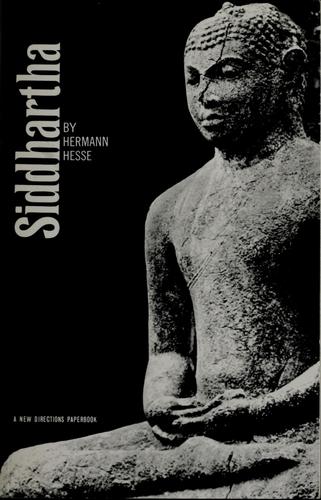
Hermann Hesse's 1922 novel is the natural graduation from The Tao of Pooh: the same preoccupation with presence, simplicity, and letting go, but embodied in a life rather than explained through a character. Siddhartha leaves home during the time of the Buddha, tries asceticism, wealth, and love, fails at all of them in instructive ways, and finally learns by sitting beside a river and listening. The destination is recognizably Hoff's: wisdom is not cleverness, striving gets in the way, and the present moment is where everything actually happens.
The difference is weight. Hesse is melancholy where Hoff is playful; Siddhartha suffers, wastes decades, and hurts people on the way to his river, and the book draws on Hindu and Buddhist thought rather than Taoism specifically. There are no jokes. It is short, the prose is simple and grave, and it rewards rereading at different ages. If The Tao of Pooh felt like a doorway, this is the first real room on the other side, and the best single next read here.
Read this if you want the calm philosophy turned into practical guidance.
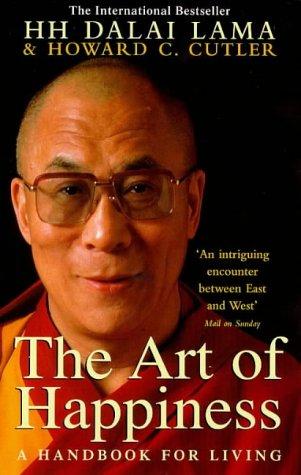
This 1998 book pairs the Dalai Lama with Howard Cutler, an American psychiatrist who interviews him over many sessions and frames his answers with Western psychology and case studies. The territory is close to Hoff's: contentment as a trainable state, compassion over acquisition, and the conviction that the unhappy mind is usually the overcomplicating mind. Where Hoff uses Pooh as the bridge between Eastern thought and Western readers, Cutler uses the consulting room, and the result is similarly approachable for someone with no background in Buddhism.
It differs in being explicitly practical and somewhat clinical. The question-and-answer structure means you get direct advice about anger, anxiety, intimacy, and suffering rather than a unifying fable, and Cutler's framing narration strikes some readers as padding around the Dalai Lama's actual words. It is also Buddhist rather than Taoist, more about training the mind than flowing with the way. Pick it when you want to do something with the serenity Hoff describes; it is the most actionable book on this list.
Read this if you are ready for the demanding version of philosophy-through-story.
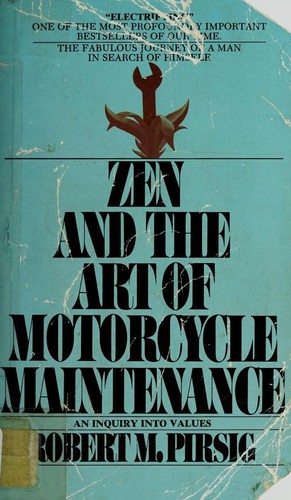
Robert Pirsig's 1974 classic shares Hoff's central move, smuggling philosophy into an unassuming vehicle, but the vehicle here is a father-son motorcycle trip across the American West, interleaved with philosophical talks Pirsig calls Chautauquas. His pursuit of Quality, the ungraspable value that precedes our division of the world into subjective and objective, lands close to the Tao that cannot be named, and his care for a well-tuned engine is wu wei with grease on its hands. Readers who sensed there was something deeper under Hoff's lightness will find the deep end here.
Know what you are signing up for. This is a long, intellectually strenuous book that detours through Greek philosophy and the narrator's own past breakdown, and the shadow self he calls Phaedrus gives the story a darkness Pooh never approaches. Some chapters are gripping; others feel like a lecture you cannot leave. It is the least gentle book on this list and the most rewarding if it catches you at the right time. Attempt it when you want to work, not relax.
Read this for pure distilled wisdom in poetry rather than play.
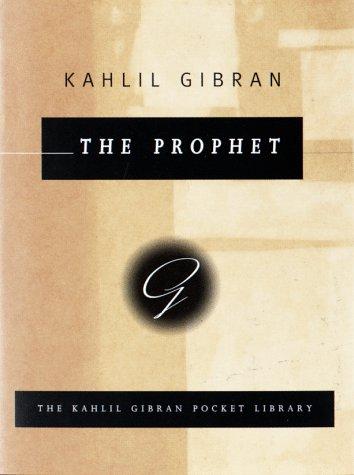
Kahlil Gibran's 1923 classic delivers what many Tao of Pooh readers are really after: short, quotable wisdom about how to live, offered in a calm and certain voice. As the prophet Almustafa prepares to sail home after twelve years in a foreign city, the people ask him to speak on love, work, children, joy, sorrow, and death, and each answer is a brief poetic essay. Like Hoff, Gibran believes the deepest truths are simple ones, and the book's counsel to hold things lightly, to let love and children be free, rhymes with the Taoist instinct not to grip.
The register is entirely different, though. Where Hoff is whimsical and conversational, Gibran is elevated and scriptural; there is no humor, no character, and no story beyond the slim frame, so readers who loved Pooh's interruptions may find it static or vague. It is best read slowly, a passage at a time, and it is the book on this list people return to at weddings and funerals. Choose it when you want the wisdom without the bear.
Read this if you want a different ancient tradition distilled to a few livable rules.
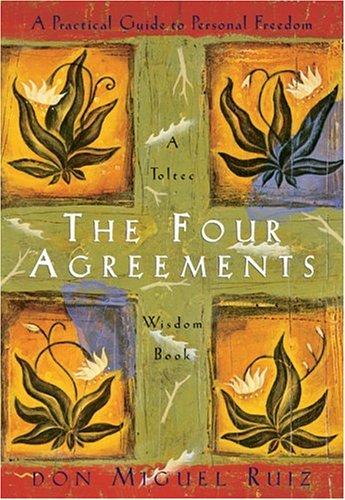
Don Miguel Ruiz's 1997 bestseller does for what he presents as Toltec wisdom roughly what Hoff did for Taoism: compresses a tradition into a short, friendly book a newcomer can absorb in a sitting. The four agreements themselves (be impeccable with your word, do not take anything personally, do not make assumptions, always do your best) point toward the same freedom from self-inflicted suffering that Hoff finds in Pooh's unbothered nature. Both books argue that misery mostly comes from mental habits we never chose and can drop.
The flavor is quite different. Ruiz is earnest and instructional where Hoff is playful and literary; there is no Piglet here, just the framework, repeated and applied. Scholars also note that the book's connection to historical Toltec culture is loose, so read it as modern self-help wearing ancient dress rather than anthropology. It is the simplest book on this list, which is both its limit and its point. Pick it when you want rules you can actually remember on a bad day.
Yes. Benjamin Hoff published The Te of Piglet in 1992, which uses Piglet to explore Te, the Taoist idea of the virtue and power of the small. It is included on this list. Most readers find it weaker than the original because Hoff spends more time on digressions about modern society, but the Hundred Acre Wood material is still charming.
Do I need to know Winnie the Pooh to enjoy The Tao of Pooh?
No. Hoff quotes and stages enough of A. A. Milne's scenes that the characters explain themselves, and most readers know Pooh, Piglet, Owl, and Eeyore well enough from childhood. Familiarity adds warmth but is not required. The book works as a standalone introduction to Taoist ideas like wu wei and the Uncarved Block.
Is The Tao of Pooh an accurate introduction to Taoism?
It is a friendly simplification, and it is usually taken as a first step rather than a final word. Hoff captures core ideas like wu wei, natural simplicity, and suspicion of cleverness, but Taoist scholars note he flattens the tradition and uses it to critique Western busyness. If it leaves you curious, the natural next step is the Tao Te Ching itself, available in many accessible translations.
What should I read after The Tao of Pooh?
For more of the same voice, The Te of Piglet is the direct sequel. For the same calm wisdom inside a real story, Siddhartha by Hermann Hesse is the best next read. For practical guidance, The Art of Happiness by the Dalai Lama and Howard Cutler turns similar ideas into advice, and Zen and the Art of Motorcycle Maintenance is the choice when you want something far more demanding.
As an Amazon Associate, we earn from qualifying purchases. · About & methodology