8 books like The Compound Effect by Darren Hardy, from Atomic Habits to The Slight Edge: small daily choices, habit science, and disciplined consistency.
Updated June 10, 2026
Darren Hardy's The Compound Effect makes one argument and makes it relentlessly: success is not produced by big dramatic moves but by small, sensible choices repeated daily and compounded over years, the way interest compounds on money. Hardy, then publisher of SUCCESS magazine, packages the idea with tracking exercises (log every expenditure, every calorie, every minute for a week), the momentum he calls Big Mo, and blunt talk about owning 100 percent responsibility for your results. It is short, direct, and more drill-sergeant than scientist; there are no studies here, just the publisher of a success magazine telling you what he has seen work.
The books below are sorted by what you want more of. If you want the same small-actions thesis with more rigor or a different angle, Atomic Habits adds systems and identity, The Power of Habit adds the actual science, and The Slight Edge is the book Hardy's argument most resembles (and which preceded it). If you want the philosophy widened beyond habits, The 7 Habits of Highly Effective People and Mindset go deeper on character and psychology. And if you want concrete daily protocols to apply tomorrow morning, The Miracle Morning, Make Your Bed, and Deep Work each turn consistency into a specific practice.
A practical note: there is real overlap in this genre, and reading all eight back to back will feel repetitive. The honest move is to pick one idea book (Atomic Habits or The Power of Habit), one philosophy book (7 Habits or Mindset), and one protocol book (Deep Work or The Miracle Morning), then actually run the experiment for ninety days, which is exactly what Hardy would tell you to do.
Read this if you want The Compound Effect's thesis upgraded into a practical system.
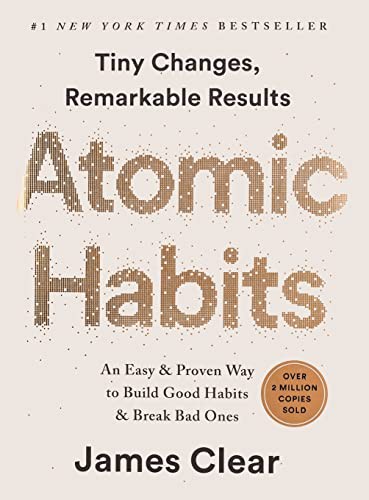
James Clear's 2018 bestseller is built on the same math as Hardy's book, tiny improvements compounding into remarkable results, and Clear even quantifies it with his famous 1 percent better every day framing. Where Hardy tells you to track your choices and take responsibility, Clear hands you machinery: the four laws of behavior change (make it obvious, attractive, easy, satisfying), habit stacking, environment design, and the two-minute rule. It is the natural next step because it answers the question The Compound Effect raises but never fully solves, which is how you actually get yourself to keep doing the small things.
The differences are tone and depth. Clear writes like an engineer where Hardy writes like a motivational speaker; Atomic Habits leans on psychology research and case studies rather than personal anecdotes and exhortation, and its identity-based framing (every action is a vote for the type of person you want to become) gives the compounding idea a foundation Hardy never builds. It has become the default habits book for a reason. If you read only one book from this list, it should be this one.
Read this if you want the book The Compound Effect most closely resembles.
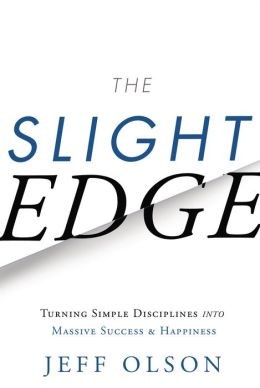
Jeff Olson's The Slight Edge, first published in 2005, makes Hardy's exact argument: simple daily disciplines, easy to do and easy not to do, compound over time into either success or failure, and most people quietly choose failure because the cost of skipping a day is invisible. Hardy and Olson come from the same world (Olson is a sales and network marketing veteran, and the books share a publisher's sensibility), and readers regularly describe the two books as interchangeable. If you wanted The Compound Effect to keep going for another two hundred pages in the same voice, this is that.
That similarity is also the caveat. Olson is more philosophical and more repetitive than Hardy, spending more time on the worldview (the curve of success versus the curve of failure) and less on concrete tracking exercises, and there is no new science or system here. Read it if the message itself is what motivates you and you want it reinforced from a second angle; skip it if you already feel you got the point and want tools, in which case Atomic Habits serves you better.
Read this for the psychology underneath why some people keep compounding and others quit.
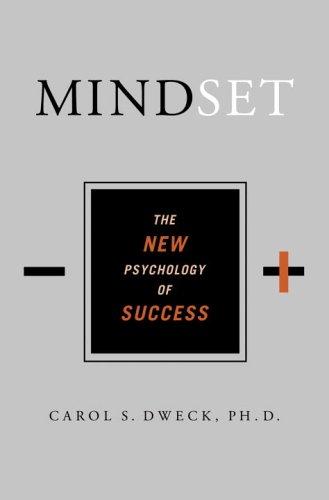
Carol Dweck is a Stanford psychologist, and Mindset supplies something The Compound Effect asserts but never explains: why some people sustain effort through the long unglamorous middle of compounding while others abandon it. Her research divides people into a fixed mindset (abilities are static, so failure is an indictment) and a growth mindset (abilities are built, so failure is information). Hardy's whole program depends on the growth side of that divide; daily disciplines only make sense if you believe incremental effort changes what you are capable of, which is precisely the belief Dweck shows can be learned.
This is a different kind of book, though: an academic's trade book full of studies, classroom experiments, and examples from sports and business, not a success manual with action steps. Some chapters (parenting, relationships, coaching) range far from self-improvement, and critics have noted that some of the supporting research has come under scrutiny in replication debates, though the core distinction has held up as a useful frame. Pick it up when you want to understand the engine rather than be handed another checklist.
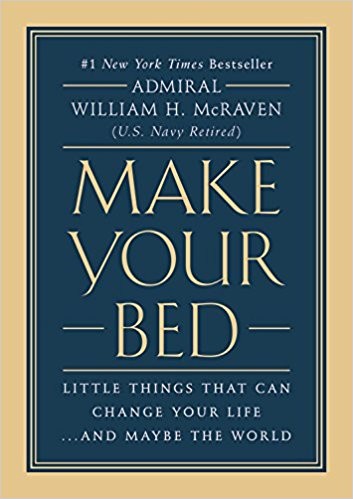
Make Your Bed: Little Things That Can Change Your Life...And Maybe the World
by Admiral William H. McRaven
Read this for the small-actions message delivered in one sitting by a Navy SEAL admiral.
Admiral William H. McRaven's book grew out of his 2014 University of Texas commencement speech, and its opening lesson is The Compound Effect in miniature: making your bed every morning means starting the day with a completed task, which compounds into more tasks done and a standard of discipline that touches everything else. The ten chapters each pair a SEAL training story with a life principle (sugar cookie inspections, surf torture, the bell you ring to quit), and the through-line is identical to Hardy's, that small disciplined acts, sustained, are what carry you through large difficulties.
Be clear about scale: this is a very short book, readable in under an hour, and it is inspiration rather than instruction. There are no tracking systems, no habit mechanics, no program to follow, just stories and a voice with earned authority. It works best as a gift, a reset, or a shot of resolve when your compounding streak has broken, not as the operating manual. Readers who found Hardy too salesy often find McRaven's plainspoken military framing more credible.
The Power of Habit: Why We Do What We Do in Life and Business
by Charles Duhigg
Read this if you want the actual science of why small actions become automatic.
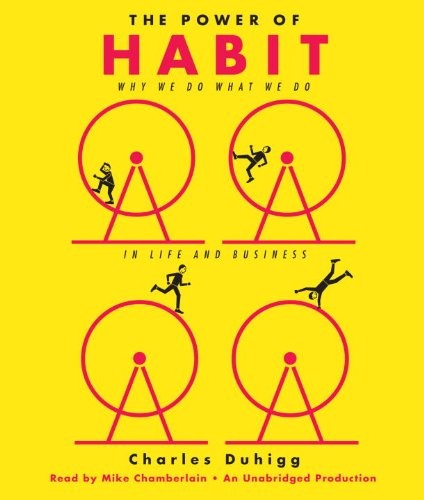
Charles Duhigg, a Pulitzer Prize-winning reporter, wrote the book that brought habit science to a mass audience in 2012, and it explains the mechanism The Compound Effect relies on but never opens up: the habit loop of cue, routine, and reward, and how behaviors migrate from effortful choices to automatic ones encoded in the basal ganglia. Hardy tells you consistency wins; Duhigg shows you why consistency gets cheaper over time, which is the neurological reason compounding works at all. The case studies, Febreze's marketing, Alcoa's safety-driven turnaround, Tony Dungy's coaching, are genuinely absorbing.
The difference is that Duhigg is a journalist telling stories about habits, not a coach giving you a program. Roughly a third of the book is about organizational and societal habits (companies, movements) rather than personal change, and the practical guidance is mostly confined to an appendix. Read it for understanding and for pleasure; pair it with Atomic Habits if you want that understanding converted into a step-by-step method.
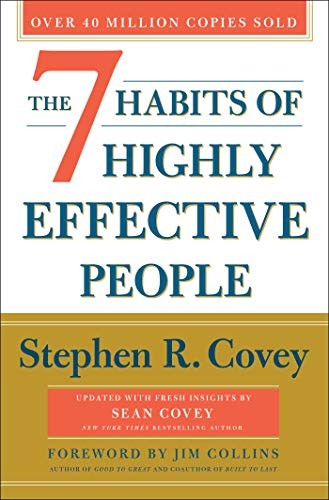
Read this for the deeper character-based classic that the whole genre stands on.
Stephen Covey's 1989 classic is the ancestor of books like The Compound Effect, and Hardy's emphasis on taking 100 percent responsibility is essentially Covey's first habit, Be Proactive, in motivational-speaker clothing. Covey's seven habits (from beginning with the end in mind through sharpening the saw) form a sequenced philosophy that moves from self-mastery to working with others, and his core distinction between the character ethic (who you are) and the personality ethic (techniques and tactics) is a direct challenge to shallower success literature. The compounding here is of character, built daily through principles rather than hacks.
It is also a heavier lift: longer, more abstract, and written in an earnest corporate-seminar register that some modern readers find dated, with frameworks (quadrants, maturity continuums, emotional bank accounts) that ask real engagement rather than quick application. Where Hardy can be read on a flight, Covey rewards slow reading and rereading. Choose it when you are ready to go from tactics to operating philosophy; it remains the most substantial book on this list.
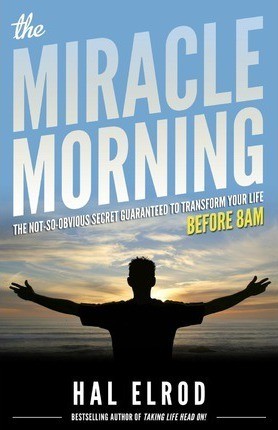
The Miracle Morning: The Not-So-Obvious Secret Guaranteed to Transform Your Life (Before 8AM)
by Hal Elrod
Read this if you want one concrete daily ritual to hang all your compounding on.
Hal Elrod's answer to The Compound Effect's challenge is to stack your small daily disciplines into a single protected hour before the day starts. His SAVERS routine (silence, affirmations, visualization, exercise, reading, scribing) is exactly the kind of daily ritual Hardy prescribes, and Elrod's personal story, recovering from a catastrophic car accident that doctors thought would end his ability to walk, gives the consistency message unusual emotional force. For readers who finished Hardy convinced but unsure where to start, this book removes the decision: start with tomorrow morning.
Honesty about the style: Elrod is even more of a motivational salesman than Hardy, the title overpromises in classic self-help fashion, and the affirmations and visualization components rest on enthusiasm rather than evidence. The book also assumes a schedule flexible enough to wake an hour earlier, which not every life allows. Take it as a framework to customize rather than a guarantee, and it can be genuinely useful; expect rigor and it will frustrate you.
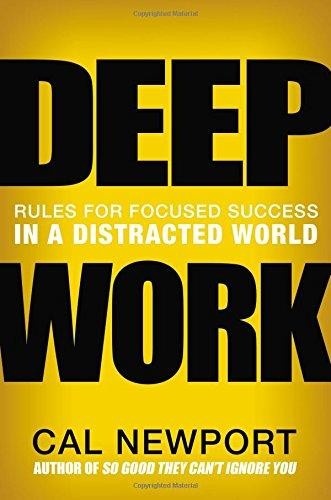
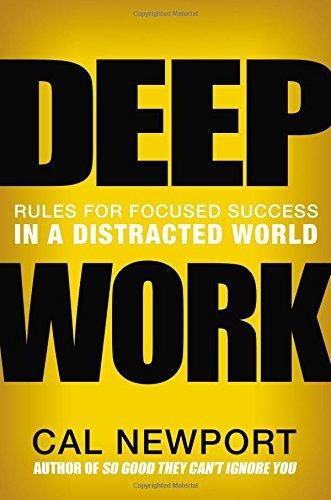
Deep Work: Rules for Focused Success in a Distracted World
by Cal Newport
Read this if you want compounding applied specifically to your career and craft.
Cal Newport's 2016 book takes the compound-interest logic and points it at attention. His argument is that the ability to concentrate without distraction on cognitively demanding work is becoming both rarer and more valuable, and that hours of deep work, accumulated daily, compound into skills and output that distracted competitors cannot match. The rules in the second half, scheduling deep blocks, embracing boredom, quitting social media, draining the shallows, are daily disciplines in exactly Hardy's sense, but aimed at professional mastery rather than general life improvement.
Newport, a Georgetown computer science professor, writes with more intellectual seriousness than anyone else on this list; he argues from examples like Carl Jung and Donald Knuth rather than from seminar-stage anecdotes, and some readers find him rigid or his prescriptions impractical for meeting-heavy or caregiving-heavy lives. It is the best pick here for knowledge workers, students, and anyone whose compounding needs to happen at a desk, and the least relevant if your goals are health, money habits, or morning-routine basics.
They share the same core thesis, but most readers get more practical value from Atomic Habits. Hardy is stronger on motivation, personal responsibility, and tracking; Clear is stronger on the mechanics of actually building and keeping habits, with a more evidence-based approach. A common path is to read The Compound Effect for the why and Atomic Habits for the how.
What is the main idea of The Compound Effect?
That small, smart choices, repeated consistently over a long period, compound into massive results, positive or negative. Darren Hardy argues there are no shortcuts: success comes from tracking your behaviors, taking full responsibility for your outcomes, building momentum through routine, and letting time multiply the effect of unremarkable daily disciplines.
Should I read The Slight Edge if I already read The Compound Effect?
Only if you want reinforcement rather than new material. The Slight Edge by Jeff Olson predates Hardy's book and makes a nearly identical argument, that easy daily disciplines compound into success while easy daily errors compound into failure. Readers who love the message often enjoy both; readers looking for new tools should go to Atomic Habits or Deep Work instead.
Is The Compound Effect based on science?
Not really. Hardy writes from experience as a success-industry publisher and mentor, using anecdotes and exercises rather than research. The thesis is consistent with what behavioral science says about habit formation and incremental progress, but if you want the evidence itself, The Power of Habit by Charles Duhigg and Mindset by Carol Dweck cover the underlying psychology and neuroscience.
As an Amazon Associate, we earn from qualifying purchases. · About & methodology