9 books like The Three-Body Problem, from The Dark Forest to Blindsight and Children of Time: hard sci-fi about first contact and humanity's place in the cosmos.
Updated June 11, 2026
Liu Cixin's The Three-Body Problem won the 2015 Hugo Award for Best Novel, the first translated work ever to do so, and it earned the prize by doing something rare: making physics itself the source of dread. Opening during China's Cultural Revolution, where the astrophysicist Ye Wenjie watches her father beaten to death for teaching relativity, it builds toward humanity's first contact with the Trisolarans, a civilization from a chaotic three-sun system, and treats that contact not as wonder but as the start of an existential trap. The ideas (the unfolding sophon, the virtual-reality game, the question of whether physics can be broken) hit harder than any character in it, and Liu would not have it any other way.
What you should read next depends on which itch the book left. If you simply want the story to continue, The Dark Forest and Death's End complete the Remembrance of Earth's Past trilogy, and the consensus is that the sequels escalate rather than fade. If it was the cold, idea-first treatment of alien contact, Blindsight and Children of Time are the strongest matches by other hands. If you want big-canvas interstellar stakes with more human texture, The Expanse Series and The Collapsing Empire deliver, while The Quantum Thief, Six Wakes, and The Long Way to a Small, Angry Planet each take one thread (dense invention, closed-loop mystery, character warmth) and run with it.
One honest note before you choose: almost nothing here is exactly like Liu. His combination of Chinese historical grounding, engineering-textbook plausibility, and total willingness to sacrifice characters to ideas is close to unique. The entries below tell you which piece of the experience each book actually reproduces, so you can pick by what you valued rather than by genre label.
Read this if you want the actual answer to the question The Three-Body Problem poses.
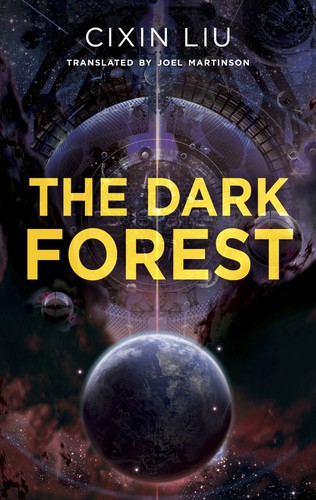
This is the direct sequel, and for many readers the best book of the trilogy. With the Trisolaran fleet centuries away and sophons making all human science transparent to the enemy, Earth's only advantage is the privacy of individual minds, so the UN appoints four Wallfacers, strategists whose plans must never be spoken aloud. The book delivers Liu's dark forest theory of the universe, an answer to the Fermi paradox so bleak and so logically constructed that the phrase has escaped the novels entirely and entered real discussions of SETI.
It is a slower starter than the first book, with a long middle section and a protagonist, Luo Ji, who spends much of it refusing his role; the female characters are also thinner than anything else in the series. Push through. The final hundred pages contain the trilogy's single most famous sequence (the Doomsday Battle) and a closing move that reframes everything. If you finished The Three-Body Problem at all engaged, this is not optional.
Read this for the trilogy's ending, which goes further than almost any science fiction ever has.
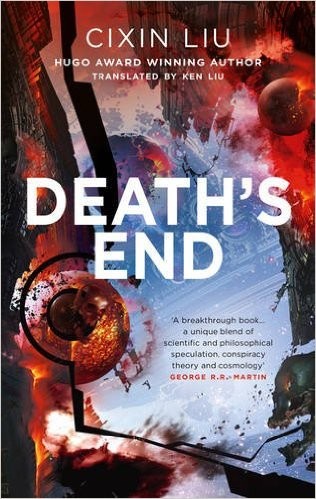
The conclusion of Remembrance of Earth's Past follows Cheng Xin, an aerospace engineer whose choices across centuries (via hibernation) repeatedly decide humanity's fate. Where the first book covered decades and the second centuries, this one spans to the literal end of the universe, taking in lightspeed travel, dimensional warfare, and what the dark forest looks like when the weapons come out. It is Liu at maximum scale, and the set pieces, especially one involving a solar system and two dimensions, are images readers report being unable to forget years later.
It is also the most divisive volume. Cheng Xin is written as the trilogy's question about whether compassion is a survival trait, and many readers find her decisions agonizing by design; the structure is episodic, and the book is long. Read the trilogy in order, this last. If you want Liu's imagination with no brakes at all, nothing else in the series, or on this list, matches it.
Read this if the sophons thrilled you and you want first contact made even colder.
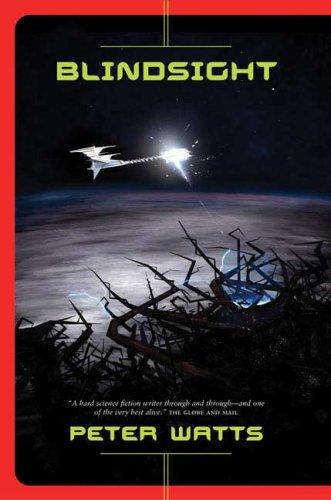
Peter Watts's 2006 novel is the most common answer to the question of what to read after Liu, and the kinship is real. A crew of modified humans (and a resurrected vampire captain, which Watts makes disturbingly plausible) intercepts an alien object at the solar system's edge, and the contact that follows is built on a genuinely unsettling scientific idea: that consciousness may be an evolutionary dead end, and that intelligence without self-awareness could be the universe's default. Like Liu, Watts treats the alien as fundamentally unknowable and treats the reader's comfort as expendable.
It is denser than The Three-Body Problem, narrated by a man whose brain surgery left him without empathy, and footnoted with real citations; some readers bounce off the prose and the relentlessness. It is also short, a single novel rather than a trilogy. Pick it if the ideas were what held you, skip it if you were already finding Liu's characters too cold. Watts has posted it free on his website for years.
Read this if you want interstellar stakes with characters you will actually love.
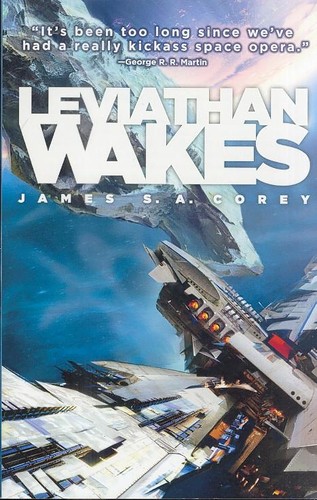
James S.A. Corey's nine-book series, beginning with Leviathan Wakes, scratches the scale itch: an alien protomolecule of unknown purpose lands in a solar system already split between Earth, Mars, and the asteroid-belt underclass, and the discovery rewrites politics, war, and eventually humanity's place in a much older galactic story. Like Liu, Corey is interested in how civilizations respond to a threat beyond their comprehension, and how short-term human factionalism persists even under existential pressure.
The texture is completely different. This is character-driven space opera with thriller pacing, banter, and a found-family crew at its heart; the physics is plausible (no artificial gravity, real orbital mechanics) but never the point the way it is for Liu. It is also a nine-book commitment, though the first novel stands alone well. Choose it when you want the cosmic dread delivered with warmth and momentum, and the Amazon TV adaptation is among the genre's best.
Read this only if you want the anti-Three-Body Problem, sincerely.
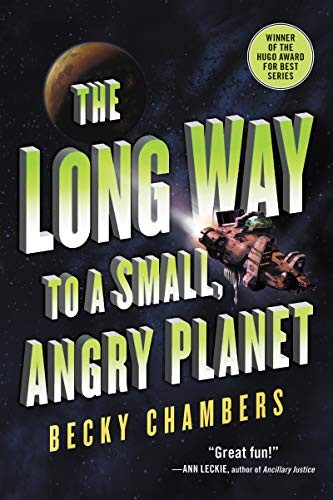
Becky Chambers's debut shares a galaxy of multiple sentient species and a real interest in how different minds and cultures misunderstand each other, which is, at bottom, the same question first-contact fiction asks. The crew of the Wayfarer, a patched-together tunneling ship punching wormholes through space, is a deliberately mixed bag of humans and aliens, and the novel's pleasures are their frictions, accommodations, and slowly earned trust on a long contract job to a dangerous system.
Be clear about what it is: cozy, episodic, character-first science fiction with low stakes and almost no interest in hard physics. There is no existential threat and no dark forest. It appears on this list as a counterweight, and it works best precisely when Liu's pessimism has worn you down. If you read The Three-Body Problem for the ideas and the dread, this will feel slight; if you finished it wishing anyone in it had a friend, start here.
Read this if you want idea density beyond even Liu, and trust yourself to keep up.
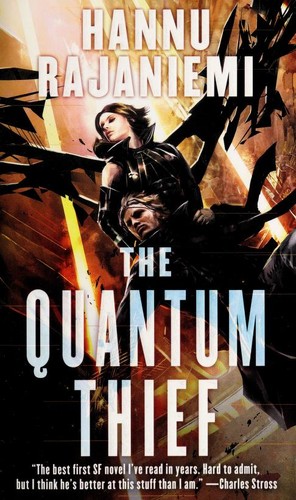
Hannu Rajaniemi, a mathematical physicist by training, writes the only book on this list that out-Lius Liu on concepts per page. A gentleman thief is broken out of a game-theoretic Dilemma Prison to pull a heist on a walking Martian city where time is currency and privacy is enforced by cryptographic memory. The post-Singularity setting is built on real physics and cryptography, and like Liu, Rajaniemi pays readers the compliment of never stopping to explain.
That is also the warning. Where The Three-Body Problem grounds its ideas in recognizable history and patient exposition, The Quantum Thief throws you into invented vocabulary from page one and lets context do all the work; it is a heist caper in structure, not a first-contact epic, and there are no aliens. Readers who loved decoding Liu's physics puzzles tend to relish it, readers who leaned on his explanations may drown. First of a completed trilogy.
Read this for deep time, civilizational stakes, and a genuinely alien other mind.
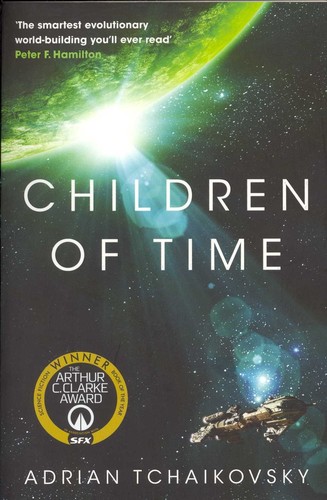
Adrian Tchaikovsky's Arthur C. Clarke Award winner is probably the closest any recent novel comes to Liu's particular sweep. A terraforming project gone wrong uplifts a species of jumping spiders instead of monkeys, and the book alternates between their civilization rising over thousands of years (science, religion, war, all rethought for spider biology) and the last ark of humanity limping toward the same planet. Like Liu, Tchaikovsky thinks in civilizations rather than individuals and builds toward a collision between two species that cannot easily comprehend each other.
The differences are mostly in Tchaikovsky's favor for many readers: the spider chapters give you characters (of a sort) to root for across generations, and the ending takes a position on the dark-forest logic of kill-or-be-killed that is fascinating to read directly against Liu's. The human chapters are weaker than the spider ones, and arachnophobes should know what they are in for. Two sequels exist; the first book is complete in itself.
Read this if the puzzle structure hooked you and you want sci-fi as a locked-room mystery.
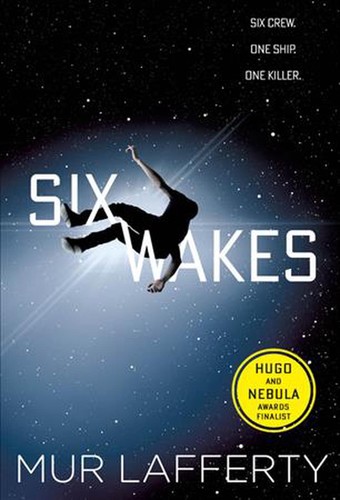
Mur Lafferty's Hugo-nominated novel connects to The Three-Body Problem through its mystery engine. Six clones wake on a generation ship with decades of memories missing and their own murdered bodies floating in the cargo bay, and since they are the only people aboard, one of them is the killer. The pleasure is the same one Liu's Red Coast reveal delivers: information withheld and released in exactly the right order, with the science (here, cloning law and consciousness mapping) doing real plot work rather than decoration.
It is a much smaller book in every sense: one ship, six characters, no aliens, no cosmic stakes, and prose that gets the job done without ambition beyond it. The ethical questions about identity and memory are genuinely chewy, but this is a weekend read, not an epic. Pick it as a palate cleanser between Liu volumes, or whenever you want the puzzle without the physics homework.
Read this if you want civilizational collapse played fast, funny, and political.
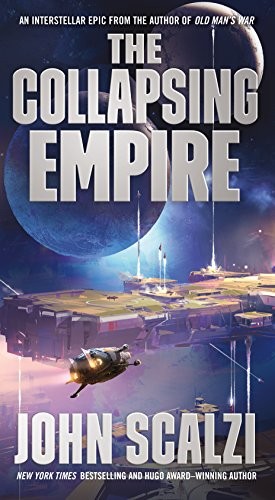
John Scalzi's Hugo-nominated series opener shares Liu's core situation: a civilization learns that physics itself has turned against it and that the institutions in charge are not built to respond. The Interdependency, an empire of habitats deliberately engineered so no system can survive alone, depends on the Flow, a network of natural faster-than-light routes, and the Flow is collapsing. The scientists who know are ignored, the powerful maneuver for advantage, and the parallel to how societies actually meet slow-moving catastrophe is the point.
Scalzi is Liu's tonal opposite. The prose is breezy, the dialogue is profane and quippy, and the books read in a sitting; there is none of Liu's austerity and no aliens at all, just humans being shortsighted at scale. Readers who wanted gravity may find it thin, and the trilogy's physics is a handwave by design. Choose it when you want the existential premise with the weight taken off.
Should I read The Dark Forest and Death's End after The Three-Body Problem?
Yes, if the first book worked for you at all. The Three-Body Problem is mostly setup; The Dark Forest delivers the trilogy's central idea (the dark forest theory of the universe) and its most celebrated sequence, and Death's End expands the scope to the end of time. Most readers rank one of the two sequels, usually The Dark Forest, as the best book in the series.
What is the best book like The Three-Body Problem not written by Liu Cixin?
Blindsight by Peter Watts is the most common recommendation, matching Liu's cold, idea-first approach to first contact with a truly alien intelligence. Children of Time by Adrian Tchaikovsky is the other top pick, sharing Liu's civilizational sweep and deep timescales while offering more characters to care about. Start with Blindsight for the dread, Children of Time for the scope.
Is The Three-Body Problem hard to read?
Moderately. The physics is explained patiently and you need no science background, but the structure jumps between the Cultural Revolution, the present day, and a virtual-reality game, and Liu prioritizes ideas over characters, which some readers find dry. Ken Liu's English translation is clear and includes footnotes for the Chinese historical context. The opening chapters set during the Cultural Revolution are widely considered the strongest in the book.
Do I need to read the books before watching the Netflix series?
No, but expect differences. Netflix's 3 Body Problem (2024), from the Game of Thrones showrunners, moves most of the story to present-day London, splits the book's protagonist into an ensemble of five friends, and pulls in material from the sequels early. The Chinese Tencent series Three-Body (2023) is far more faithful to the first novel. The books go much further than either adaptation has yet reached.
As an Amazon Associate, we earn from qualifying purchases. · About & methodology