6 books like When the Heavens Went on Sale by Ashlee Vance, from The Martian to Cosmos and Black Hole Blues, for readers hooked on space and the people chasing it.
Updated June 10, 2026
When the Heavens Went on Sale is Ashlee Vance's 2023 chronicle of the new commercial space race, the scrappy era that followed SpaceX. Vance, who wrote the bestselling Elon Musk biography, spent years embedded with four startups (Planet Labs, Rocket Lab, Astra, and Firefly Aerospace) as they raced to build cheap rockets and satellite constellations, and the book's pleasure is its access: launchpad failures, founder feuds, investors burning money, engineers improvising in sheds and on remote islands. It is a business and character story as much as a space story, told with Vance's wiseguy humor.
An honest note about this list: it leans toward the science and wonder side of space rather than the startup side. If what hooked you was the cosmos itself, the thing all those rockets are pointed at, Cosmos and Astrophysics for People in a Hurry give you the grand tour, and A Brief History of Time and The Universe in a Nutshell go deeper into the physics. Black Hole Blues is the closest in spirit to Vance, a journalist-quality account of obsessive people gambling decades on hard engineering. The Martian is the fiction pick, engineering improvisation turned into a survival thriller.
Practical guidance: if you mainly wanted more business-of-space reporting, the closest matches are actually Vance's own Elon Musk biography and Eric Berger's Liftoff, about SpaceX's early days, neither of which is on this list. Read the entries below by what you want next: the science, the obsessives, or the fun.
Read this if the rockets made you want to understand the universe they fly into.
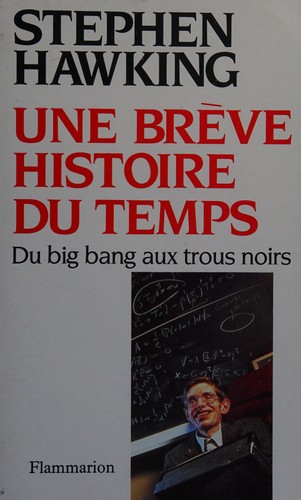
Stephen Hawking's 1988 classic is the gateway book for the physics behind everything Vance's founders take for granted: gravity, time, the structure of the cosmos. Where When the Heavens Went on Sale is about getting hardware a few hundred kilometers up, Hawking is about what the whole arena actually is, from the Big Bang to black holes to the arrow of time, explained for general readers with famously only one equation in the text. If Vance's book reawakened a childhood space obsession, this is the canonical next step on the science side.
Know what you are switching to: there are no characters, no startups, and no narrative momentum here, just concepts built patiently one on another. It is short but genuinely demanding in places, and many buyers famously stall partway through. Read it a chapter at a time rather than like the page-turner Vance wrote, and you will come out the other side understanding the universe better than most people you know.
Read this if you want Hawking's ideas with more visuals and less grind.
This 2001 follow-up to A Brief History of Time covers much of the same cosmological territory, relativity, quantum theory, the shape of time, plus newer material on branes and string theory, but in a heavily illustrated, more modular format. Each chapter largely stands alone, and the diagrams do real explanatory work, which makes it the friendlier of the two Hawking books for readers coming from a fast narrative like Vance's rather than from a physics background.
It is still theoretical physics, further from Vance's launchpads than anything else on this list, and the speculative later chapters have aged unevenly as science has moved on. The honest recommendation: pick either this or A Brief History of Time rather than reading both back to back, since they overlap substantially. Choose this one if you are a visual learner or were intimidated by the first book's reputation.
Read this for the wonder that made people want to commercialize space in the first place.
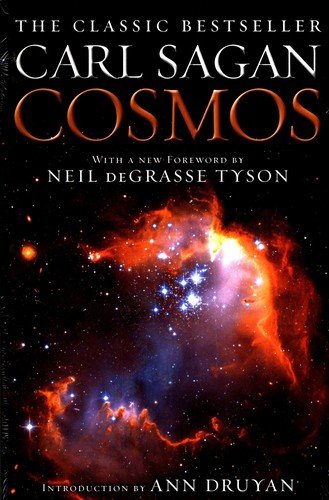
Carl Sagan's 1980 classic, the companion to his landmark TV series, is the book that put the space dream into an entire generation, including the kind of engineers and founders Vance profiles. It moves from the origins of life to the evolution of galaxies to the history of astronomy, all in Sagan's warm, humane voice, and it shares with Vance's book a conviction that space is not a niche interest but a human project. If When the Heavens Went on Sale is about the people cashing in on the dream, Cosmos is the dream itself, stated as well as it has ever been stated.
It is a product of 1980, so some of the science has been superseded and the Cold War framing dates it, though the writing has not aged at all. There is no business story and no irony; Sagan is sincere in a way Vance never quite allows himself to be. Read it slowly, ideally alongside images of the actual objects he describes. It remains the best single book for rekindling awe about the universe.
Read this if you want the cosmic background briefing in airport-read form.
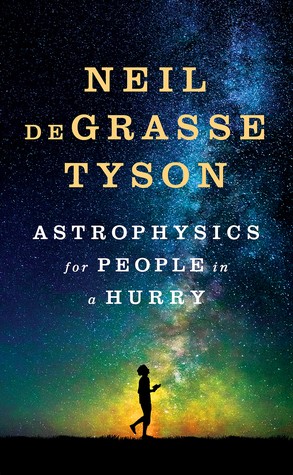
Neil deGrasse Tyson's 2017 bestseller is the fastest way to backfill the science behind the space economy: a couple hundred small-format pages covering the Big Bang, dark matter, dark energy, and our place in the cosmos, in short chapters built for commutes. Tyson's jokey, conversational tone is the closest on the science side of this list to Vance's own register, and the book asks nothing of you except attention. If you liked that When the Heavens Went on Sale never got bogged down, this is the matching physics book.
The tradeoff is depth. Each topic gets a flyby rather than a landing, and readers who want to actually sit with the ideas will find Hawking or Sagan more nourishing. There are also no people in it, no struggling engineers or driven founders, just concepts. Treat it as the briefing document: read it in two sittings, then decide which subject deserves a whole book.
Read this if the duct-tape engineering was your favorite part.
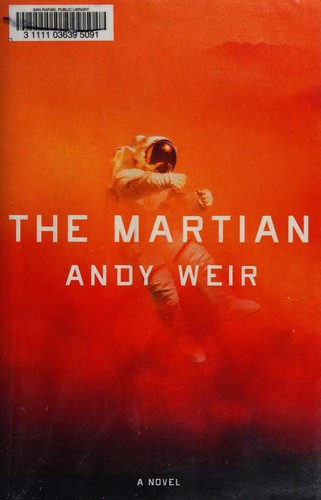
Andy Weir's novel is fiction, but it runs on the exact fuel that powers Vance's best chapters: smart, profane people solving hardware problems with whatever is on hand, under absurd constraints, with failure meaning death instead of just bankruptcy. Astronaut Mark Watney, stranded alone on Mars, sciences his way through growing food, making water, and rigging communications, and Weir shows the math and the duct tape. The improvisational, fix-it-with-what-you-have spirit of Astra's island launches and Rocket Lab's early days is this book's entire plot.
It is also simply more fun than anything else on the list, genuinely funny and relentlessly paced, which makes it the right pick when you want pleasure rather than education. The characters are thin beyond Watney and the prose is workmanlike; nobody reads Weir for sentences. But as a celebration of engineering as heroism, it is the natural fiction companion to Vance's nonfiction, and it converted a lot of non-science readers into space people.
Read this for obsessive people betting decades on impossible hardware, Vance's formula applied to pure science.
Janna Levin's 2016 book is the closest structural match to When the Heavens Went on Sale: a character-driven account of a wildly ambitious engineering gamble, in this case LIGO, the decades-long effort to build detectors sensitive enough to hear gravitational waves from colliding black holes. Like Vance, Levin focuses on the flawed, fascinating people, the founders' rivalries, the funding crises, the years of failure before the payoff, and she happened to finish just as LIGO made its historic 2015 detection. It reads as the scientific sibling of Vance's commercial story.
The differences are scale and stakes: LIGO was a public, billion-dollar science project rather than venture-backed startups, and the prize was knowledge rather than market share. Levin, an astrophysicist herself, writes more lyrically than Vance and goes deeper into the physics, though never impenetrably. If you take one recommendation from this list, take this one; it preserves the people-and-hardware drama you came for while teaching you something profound.
It is Ashlee Vance's 2023 nonfiction account of the commercial space boom that followed SpaceX. Vance embedded with four startups, Planet Labs, Rocket Lab, Astra, and Firefly Aerospace, as they raced to build cheap rockets and satellite networks. It is a business and character story full of launch failures, founder drama, and venture capital, written with the same access-driven style as his Elon Musk biography.
What should I read for more books about the space business specifically?
The closest companions are Ashlee Vance's own Elon Musk biography, which covers SpaceX's rise in depth, and Eric Berger's Liftoff, about SpaceX's desperate early Falcon 1 years. Christian Davenport's The Space Barons covers Musk, Bezos, and the billionaire space race. On this list, Black Hole Blues is the nearest match in spirit, an engineering moonshot told through its obsessive people.
Do I need a science background for the books on this list?
No. The Martian and Astrophysics for People in a Hurry are fully accessible to anyone. Cosmos and Black Hole Blues are written for general readers with no math required. A Brief History of Time and The Universe in a Nutshell are the most demanding, but both were written for non-scientists; they just reward slow reading.
Is When the Heavens Went on Sale a sequel to Vance's Elon Musk book?
Not a sequel, but a follow-on. The Musk biography (2015) told the story of SpaceX proving that private rockets could work; When the Heavens Went on Sale picks up the consequences, the wave of smaller startups and investors who rushed into orbit afterward. Musk appears only at the edges. You can read either book first without losing anything.
As an Amazon Associate, we earn from qualifying purchases. · About & methodology