8 books like A Brief History of Time, from Cosmos to The Elegant Universe: popular physics and cosmology picks matched to what you loved in Hawking.
Updated June 11, 2026
Stephen Hawking's A Brief History of Time did something almost no science book had done before 1988: it put black holes, the Big Bang, imaginary time, and the search for a theory of everything on bedside tables by the tens of millions. Its famous constraint, that every equation would halve the sales, so it contains only E=mc2, forced Hawking to explain general relativity and quantum mechanics in plain sentences and thought experiments. Plenty of buyers never finished it, which became its own joke, but the book's mix of big questions (where did the universe come from, does it need a creator, why does time run one way) with genuine physics is exactly what its readers want more of.
The books below are sorted by which part of Hawking you want to continue. If you want more Hawking himself, The Universe in a Nutshell is his own follow-up. If you want the cutting edge he pointed toward, Brian Greene's The Elegant Universe and The Fabric of the Cosmos take string theory and the nature of spacetime further than Hawking could in 1988, and A Universe from Nothing tackles the something-from-nothing question head on. If what you loved was the voice, the sense of a great mind making the cosmos feel personal, Cosmos and Six Easy Pieces deliver that, and Astrophysics for People in a Hurry and Our Cosmic Habitat give you the quick tour and the philosophical wide shot.
A practical note: these range from an afternoon read (Astrophysics for People in a Hurry) to genuinely demanding (The Fabric of the Cosmos). None require math, but the Greene books reward slow reading. Each entry below says which itch from A Brief History of Time it scratches and how hard it works you.
Read this if you want the theory of everything Hawking was chasing.
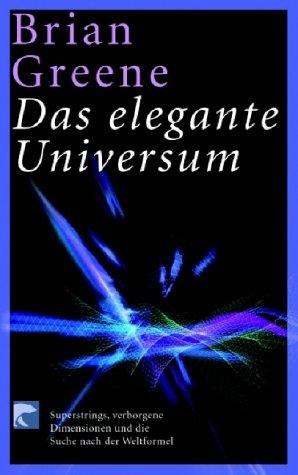
A Brief History of Time ends with the dream of a single theory uniting general relativity and quantum mechanics, and Brian Greene's 1999 book is the most famous popular account of the leading candidate, string theory. Greene explains relativity and quantum mechanics from scratch in the first third, covering much of the same ground as Hawking but with more patience and more analogies, then builds up to vibrating strings, extra dimensions, and the hope of one framework behind everything. The ambition is exactly the one Hawking set up.
It is a noticeably harder book than Hawking's, longer and denser, and its central subject has a real caveat: string theory remains unconfirmed by experiment decades later, so read it as a tour of a beautiful idea rather than settled science. Greene is honest about this. Pick it up if the final chapters of A Brief History of Time were your favorite part and you want the full version of the quest; skip ahead to Cosmos or Tyson if you wanted breadth rather than depth.
Read this if you want the same awe with a warmer, more human voice.
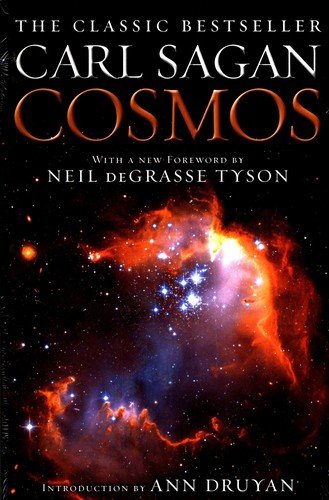
Carl Sagan's 1980 classic, the companion to his television series, is the other pillar of popular science from Hawking's era, and Sagan actually wrote the introduction to the first edition of A Brief History of Time. Cosmos covers the history of astronomy, the evolution of life, the deaths of stars, and humanity's place in an enormous universe, and it shares Hawking's conviction that ordinary readers deserve the biggest questions. Where Hawking is wry and compressed, Sagan is expansive and openly moved by what he describes.
The difference is scope and temperature. Cosmos is less about theoretical physics (you will not get much on quantum mechanics or black hole thermodynamics) and more about science as a human story, from the library of Alexandria to the Voyager probes. Some of the planetary science is dated, but the writing has aged better than almost any science book of its generation. Choose it if A Brief History of Time left you wanting wonder and perspective more than equations explained.
Read this for the deepest dive into space and time themselves.
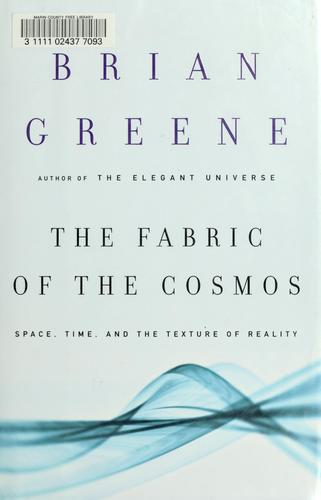
Greene's 2004 follow-up is the closest match on this list to Hawking's actual subject matter. It is organized around the questions A Brief History of Time raises and then moves past: what space and time actually are, why time has an arrow, what quantum entanglement means for reality, and how inflation explains the universe's first instants. Greene covers the same ground Hawking covers on relativity and quantum theory but with two extra decades of physics, including a much fuller treatment of cosmological inflation.
It is the most demanding book here, longer than The Elegant Universe and more philosophical, with extended thought experiments that ask real concentration. The reward is that it goes further than Hawking on the questions Hawking made you care about, especially the arrow of time. Read The Elegant Universe first if you want string theory specifically; read this one if 'what is time, really' is the question that stuck with you.
Read this if you want the modern refresher in a single sitting.
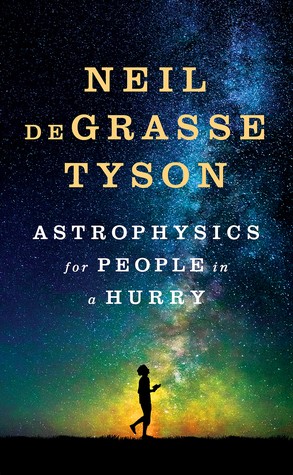
Neil deGrasse Tyson's 2017 bestseller is built on the same bet Hawking made: that a general reader will follow the Big Bang, dark matter, and the shape of the cosmos if you strip the math and keep the ideas. Assembled from Tyson's essays, it runs through what physics learned in the decades after A Brief History of Time, including dark energy, which Hawking's 1988 edition predates entirely. The tone is light, joke-forward, and confident, and each chapter stands alone.
It is also the thinnest book here in both senses. At around two hundred small pages it skims where Hawking digs, and you will not get the sustained arguments about time, black holes, or quantum gravity that gave A Brief History of Time its weight. Treat it as an update and a palate cleanser, ideal if you read Hawking years ago and want a fast pass through what changed, or if you abandoned Hawking halfway and want an easier on-ramp back.
This is Hawking's own 2001 sequel, written in part for the many readers who bought A Brief History of Time and stalled. It revisits relativity and quantum theory, then moves into what occupied Hawking in the years between: imaginary time, branes, supersymmetry, the possibility of time travel, and the state of the search for a complete theory. The dry wit is the same, and the structure is friendlier, with a hub-and-spoke design where chapters can be read independently rather than as one cumulative argument.
The trade-off is that it leans heavily on full-color illustrations to carry ideas the text compresses, which some readers find clarifying and others find like reading an extended caption. It also assumes a bit of comfort with the first book's concepts. It won the Aventis science book prize in 2002. Choose it for Hawking's voice on newer physics; choose Greene if you want those same topics argued out at full length.
Read this for the big philosophical questions handled by a working cosmologist.
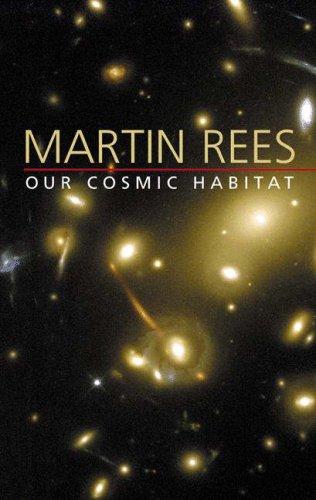
Martin Rees, the UK's Astronomer Royal and a longtime colleague of Hawking's at Cambridge, writes here about the questions that hover behind A Brief History of Time: why the universe's constants seem tuned to allow stars, chemistry, and life, and whether our universe might be one of many. Hawking raises the anthropic principle briefly; Rees, who did serious technical work on these questions, gives it a full and careful treatment, including an early popular case for the multiverse idea.
It is a quieter, more speculative book than the others on this list, closer to an extended essay than a survey, and it spends less time teaching you physics than reflecting on what the physics implies. Rees is scrupulous about flagging what is established and what is conjecture. Pick this if the 'why is there something rather than nothing, and why this something' thread is what A Brief History of Time left you holding.
Read this if Hawking's question about what banged in the Big Bang stuck with you.
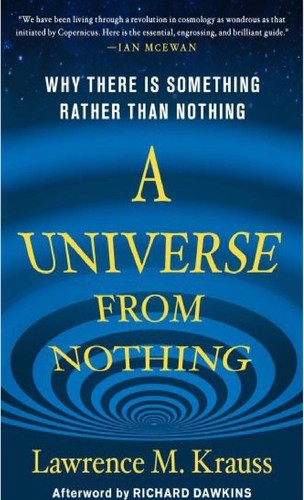
Lawrence Krauss's 2012 book takes the most provocative question in A Brief History of Time, whether the universe needs a cause or a creator, and answers it with modern cosmology. Krauss explains how quantum physics allows particles, and arguably space and time themselves, to arise from nothing, and walks through the observational evidence (the flatness of the universe, dark energy, the cosmic microwave background) that supports this picture. It directly extends Hawking's no-boundary speculation with two decades of data Hawking did not have in 1988.
Know what you are picking up: the book has an explicit point of view. It grew out of a viral lecture, includes an afterword by Richard Dawkins, and argues openly against the need for a creator, which made it controversial, and philosophers have pushed back on whether the quantum vacuum really counts as 'nothing.' The physics writing is clear and the cosmology is solid. Choose it if you want the something-from-nothing argument made in full; pass if you want physics without the religion debate attached.
Read this if you want the foundations under Hawking, taught by physics' best explainer.
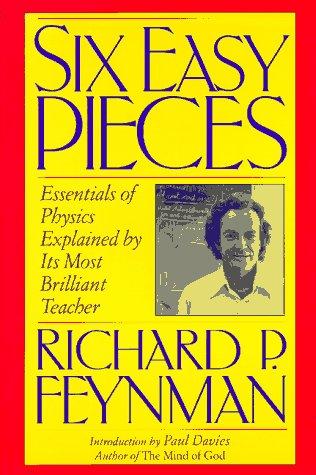
Six Easy Pieces collects the six most accessible lectures from Richard Feynman's legendary 1960s Caltech course, covering atoms, basic physics, the relation of physics to other sciences, conservation of energy, gravitation, and quantum behavior. It shares the quality Hawking's readers prize most, a brilliant physicist explaining hard ideas in plain language with visible delight, and the closing lecture on quantum behavior remains one of the best introductions to the strangeness Hawking builds on ever written.
The difference is altitude. Hawking writes about the frontier, black holes and the origin of the universe; Feynman is teaching the fundamentals beneath all of it, and there is no cosmology here at all. These are transcribed lectures, so the voice is conversational, with digressions intact. Read it if A Brief History of Time made you want to actually understand physics from the ground up rather than tour its newest results. It pairs naturally with everything else on this list.
What book is most similar to A Brief History of Time?
Hawking's own The Universe in a Nutshell is the closest in voice and subject, since it is his sequel covering relativity, quantum theory, and the search for a unified theory with updated physics. Among other authors, Brian Greene's The Fabric of the Cosmos matches the topics most directly, while Carl Sagan's Cosmos is the closest in cultural stature and broad appeal.
Is A Brief History of Time still accurate?
The core physics holds up, including relativity, quantum mechanics, black hole evaporation, and Big Bang cosmology. But the book predates major discoveries, most notably dark energy and the accelerating expansion of the universe (1998), the Higgs boson (2012), and gravitational wave detection (2015). Newer books like Astrophysics for People in a Hurry or The Fabric of the Cosmos cover those developments.
I found A Brief History of Time hard to finish. What should I read instead?
Start with Astrophysics for People in a Hurry, which covers similar territory in short standalone chapters you can read in a sitting. Cosmos is also easier going because it is driven by stories rather than sustained arguments. Once those land, Hawking's The Universe in a Nutshell is friendlier than the original because its chapters can be read in any order.
What should I read after Hawking if I want a theory of everything?
Brian Greene's The Elegant Universe is the standard next step, explaining string theory, the leading attempt to unify general relativity and quantum mechanics, for general readers. Follow it with The Fabric of the Cosmos for a deeper treatment of space and time. Keep in mind that string theory remains experimentally unconfirmed, so this is a tour of an active research program, not settled physics.
As an Amazon Associate, we earn from qualifying purchases. · About & methodology