8 books like The E-Myth Revisited, from The Lean Startup to Good to Great: building businesses that run on systems, not on the founder's hours.
Updated June 10, 2026
Michael Gerber's The E-Myth Revisited is built on one diagnosis that has stuck for decades: most small businesses are not started by entrepreneurs but by technicians having an entrepreneurial seizure. The baker who is great at baking opens a bakery and discovers she now owns a job, not a business. Gerber's fix is to work on the business rather than in it: to build systems, documented processes, and an organization that could run as a franchise prototype even if you never franchise, all taught through a running dialogue with Sarah, a struggling pie shop owner. The advice is repetitive and the franchise evangelism gets heavy, but the core idea has outlasted thousands of slicker books.
What you should read next depends on which Gerber problem is yours. If you are starting or testing a business, The Lean Startup and The Art of Start 2.0 cover validation and launch, the stage before Gerber's systems matter. If you are buried in your own company and need to get out of the technician role, The 4-Hour Workweek and Entrepreneur Revolution push the delegation and design logic further. If you want the research-grade version of building an enduring organization, Good to Great and Built to Last are the serious texts, with Start with Why supplying the purpose layer and The Hard Thing About Hard Things supplying the unvarnished reality check.
One practical note: these books split between small-business advice and big-company research, and the gap matters. Collins studied Fortune 500-scale companies; Gerber's reader owns a pie shop. Each entry below says which world it lives in so you can match it to the size of your actual problem.
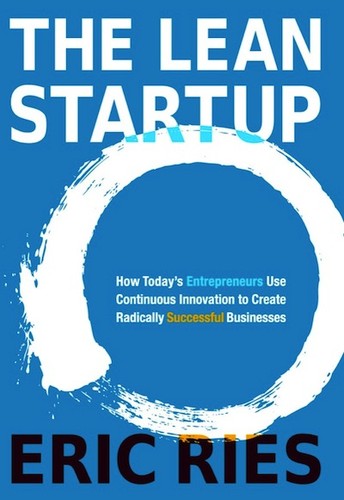
Read this if you are still proving the business works before you systematize it.
Eric Ries shares Gerber's central conviction that a business should be treated as a designed system rather than an extension of the founder's hustle. Where Gerber asks you to document processes as if building a franchise prototype, Ries asks you to treat the whole company as a series of testable experiments: build a minimum viable product, measure real customer behavior, and learn whether to persevere or pivot. Both books are fundamentally about replacing founder gut-feel with a repeatable method, and Ries's build-measure-learn loop is the systems thinking Gerber preaches, applied to the question Gerber skips: is this business worth building at all?
The context is different, though. Ries writes from the world of tech startups under extreme uncertainty, and his vocabulary (validated learning, innovation accounting, pivots) fits a software company more naturally than a plumbing business or a pie shop. Gerber's reader usually already has customers; Ries's reader is still searching for a product people want. Pick this before E-Myth-style systematization if your real risk is building something nobody buys. It is the most influential business book of its decade for a reason.
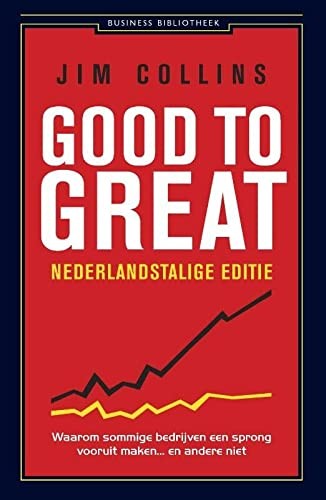
Good to Great: Why Some Companies Make the Leap... and Others Don't
by Jim Collins
Read this for the research-backed version of building a company that outgrows its founder.
Jim Collins answers Gerber's question, why do some businesses work while most do not, with five years of research instead of a parable. His team compared companies that made a sustained leap to great results against near-identical companies that did not, and the findings rhyme with Gerber constantly: Level 5 leaders build companies rather than monuments to themselves (the technician's opposite), first who then what is delegation done seriously, and the flywheel is the compounding payoff of disciplined, systematized effort over years. It is the grown-up, evidence-based case for working on the business.
The gap is scale and tone. Collins studied large public companies like Walgreens and Kroger, not eight-person shops, and the book is analytical where Gerber is conversational, with no equivalent of the Sarah dialogue to carry you. Some of its celebrated companies, Circuit City and Fannie Mae among them, later collapsed, a fair caution about how durable such findings are. Read it when your business already works and your ambition has moved from surviving to building something institutional.
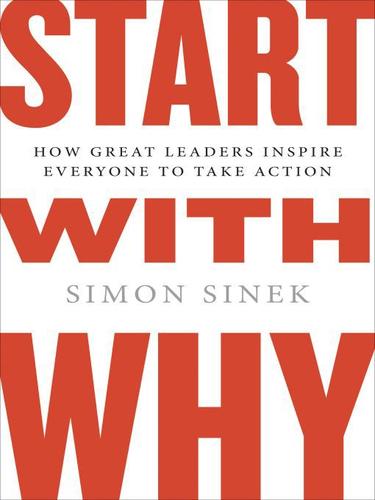
Start with Why: How Great Leaders Inspire Everyone to Take Action
by Simon Sinek
Read this if your systems are in place but nobody, including you, remembers the point.
Simon Sinek's book supplies the layer Gerber touches only briefly through his idea of the business serving the owner's primary aim in life. Sinek argues that lasting companies start from why, a purpose beyond profit, and let the what and how flow from it, illustrated through his golden circle and the examples of Apple, Southwest Airlines, and Martin Luther King Jr. For an E-Myth reader, this is the missing soul of the franchise prototype: systems tell your people what to do, but a clear why is what makes customers loyal and employees care about following the system at all.
Be honest about what it is, though: one idea, stated early and then circled for two hundred pages, with anecdotes chosen to fit and little practical machinery for a small-business owner. It began as a TED talk and reads like an extended one. Gerber gives you more to actually do on Monday. Read Sinek quickly for the framing, which is genuinely useful when writing your company's purpose into Gerber-style documentation, and do not expect an operations manual.
Read this for what the franchise-prototype idea looks like at hundred-year scale.
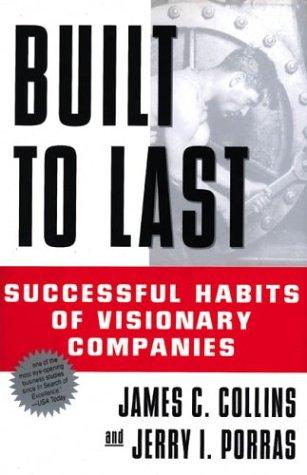
Collins and Porras's study of visionary companies is, in a sense, The E-Myth Revisited's endgame. Its most famous idea, be a clock builder rather than a time teller, is exactly Gerber's distinction between the technician who is the business and the entrepreneur who builds a business that runs without them. The visionary companies in the study, 3M, Johnson & Johnson, Disney and others, are organizations whose founders built cultures, systems, and core ideologies durable enough to outlive them, which is the franchise prototype thinking carried across generations.
This is the furthest book on the list from a small-business owner's daily reality. The companies are giant, the horizon is decades, and the prose is academic-adjacent, denser than Good to Great (it came first, in 1994, and shows its age in places). Treat it as philosophy rather than playbook: read it for conviction about what building an enduring institution means, after Gerber has fixed your week and Collins has framed your decade.
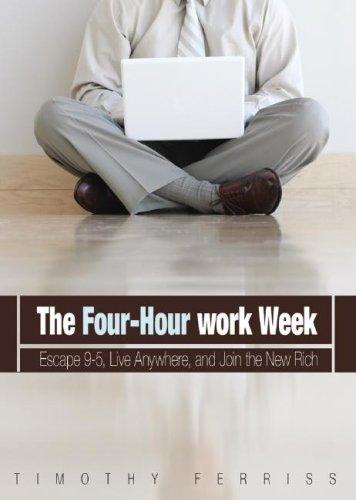
The 4-Hour Workweek: Escape 9-5, Live Anywhere, and Join the New Rich
by Tim Ferriss
Read this if you want Gerber's escape from the technician role pushed to its limit.
Tim Ferriss's book is The E-Myth Revisited's logic taken to an extreme conclusion. Gerber wants you working on the business instead of in it; Ferriss wants you out of it almost entirely, running a business designed from the start for automation, outsourcing, and the owner's absence. His DEAL framework (definition, elimination, automation, liberation) is a systemization program a Gerber reader will recognize immediately: document what you do, delegate or automate it, measure only what matters, and stop equating hours worked with value created.
The differences are temperament and credibility. Gerber is building a real company that serves customers for decades; Ferriss is engineering a lifestyle, and parts of the book, the outsourced personal assistants, the drop-shipped products, the 2007-era internet tactics, have aged into period pieces. Some of it reads as gaming systems rather than building them. Read it selectively, for the delegation mindset and the permission to design your role out of the business, and leave the lifestyle maximalism on the shelf if it is not yours.
The Art of the Start 2.0: The Time-Tested, Battle-Hardened Guide for Anyone Starting Anything
by Guy Kawasaki
Read this for the launch-stage checklist Gerber assumes you have already survived.
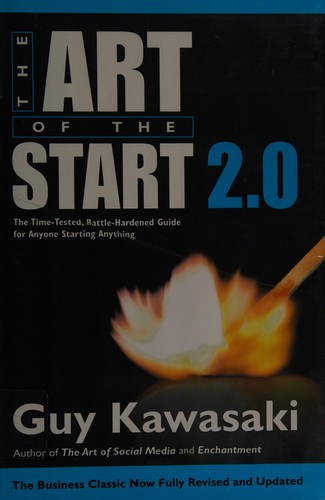
Guy Kawasaki covers the ground that comes before The E-Myth Revisited: actually getting a venture off the ground. Drawing on his years as Apple's software evangelist and later as a venture capitalist, he works through positioning, pitching, fundraising, recruiting, and evangelizing a product, with famously concrete rules like the 10/20/30 standard for pitch decks (ten slides, twenty minutes, thirty-point font). Like Gerber, he is allergic to romanticism about entrepreneurship; the battle-hardened subtitle is the same spirit as Gerber's insistence that passion for the craft is not a business plan.
It is a different tool for a different moment. Kawasaki's frame is startups seeking growth and often investors, not the dry cleaner or pie shop Gerber writes for, and the book is organized as reference material, lists and checklists you dip into, rather than a narrative argument you read through. The 2.0 edition updates the 2004 original for the social media era. Pick it up at the starting line; pick Gerber up once the doors are open and the chaos begins.
Read this when the systems exist and things are going wrong anyway.
Ben Horowitz provides the corrective to every tidy framework on this list, Gerber's included. Drawing on his time as CEO of Loudcloud and Opsware, companies that nearly died repeatedly before a $1.6 billion sale to HP, he writes about the problems no operations manual covers: laying people off, demoting a loyal friend, managing your own psychology when the company is weeks from failure. It shares Gerber's bluntness about why businesses fail, but where Gerber says the cure is systems, Horowitz says some problems have no recipe, only judgment under pressure.
The setting is venture-backed Silicon Valley at war, not Main Street, and a small-business owner will need to translate: the chapters on executive hiring and board management may never apply to a five-person shop, while the chapters on hard calls and self-management apply to anyone. The rap epigraphs and war stories make it the most readable book here. Treat it as the antidote to over-believing that documentation alone, Gerber-style, will save you.
Read this if you want Gerber's mindset shift restated for the digital small business.
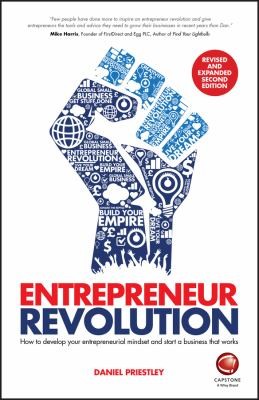
Daniel Priestley is working Gerber's exact seam: the shift from employee-and-technician thinking to entrepreneurial thinking, aimed at ordinary people building small businesses rather than venture-backed founders. His argument that the industrial-age career is dissolving and that small, agile, personality-driven businesses are the opportunity of the era updates Gerber's premise for a world of laptops and global reach, and his emphasis on building a business that works (the phrase is right there in his subtitle, as in Gerber's pages) keeps the focus on systems and teams over solo hustle.
It is the lightest book on this list, more motivational and more openly connected to Priestley's own training and accelerator businesses, so expect cheerleading alongside the frameworks and some repetition of ideas Gerber states more durably. UK-flavored examples and the entrepreneur-versus-employee framing will energize some readers and grate on others. Choose it if The E-Myth Revisited felt dated in its examples and you want the same conviction delivered in a contemporary, digital-economy voice.
What book is most similar to The E-Myth Revisited?
Among well-known business books, the closest in spirit on this list is Entrepreneur Revolution by Daniel Priestley, which targets the same reader, a small-business owner who needs to stop thinking like a technician. Off this list, Gerber readers most often pair it with books in the systemization lane it created, such as Built to Sell by John Warrillow, Traction by Gino Wickman, and Clockwork by Mike Michalowicz, all of which operationalize the work-on-your-business idea.
Should I read The E-Myth Revisited or The Lean Startup first?
It depends on your stage. If you have not yet proven that customers will pay for what you offer, read The Lean Startup first; its validation loop addresses the risk Gerber largely assumes away. If your business already has customers and the problem is that everything depends on you, The E-Myth Revisited is the right book, because your bottleneck is systems and delegation, not product discovery.
Is The E-Myth Revisited still relevant?
The core ideas hold up well: the technician trap, working on rather than in the business, and documenting systems so the business can run without you are as true for a modern service business as for the 1995 original's audience. What has aged is the packaging, the long Sarah pie-shop dialogue, the heavy franchise framing, and the absence of anything about the internet. Many readers skim the repetition and keep the framework.
What does the E-Myth actually mean?
The E-Myth is the entrepreneurial myth: the assumption that people who start businesses are entrepreneurs. Gerber argues most are technicians, people skilled at a craft who wrongly believe that understanding the technical work means understanding a business that does that work. The result is an owner who has bought a job. His remedy is to balance three roles, entrepreneur, manager, and technician, and to build the business on documented systems.
As an Amazon Associate, we earn from qualifying purchases. · About & methodology