6 books like The Silmarillion, from Unfinished Tales to The Worm Ouroboros and The Mabinogion: mythic, archaic, epic reads for Tolkien's deep-lore fans.
Updated June 10, 2026
The Silmarillion is not a novel and was never meant to read like one. Published in 1977 by Christopher Tolkien from his father's lifelong manuscripts, it is the mythology behind Middle-earth: a creation myth sung into being by the Ainur, the rebellion of Feanor over the three Silmarils, the long ruinous wars against Morgoth (Sauron's original master), and tragedies like Beren and Luthien and the tale of Turin that Tolkien worked on for sixty years. The prose is deliberately biblical and the cast is enormous. People who bounce off it wanted The Lord of the Rings again; people who love it wanted exactly this, a legendarium.
This list assumes you are in the second camp, and it is organized by what you want more of. If the answer is simply more Middle-earth at this depth, Unfinished Tales of Numenor and Middle-earth is the direct continuation. If you want the real mythologies Tolkien drew from, The Mabinogion is the medieval source material itself. If you want invented worlds with the same elevated register and mythic sweep, The Worm Ouroboros (which Tolkien himself read and admired) and A Wizard of Earthsea deliver it, while The Chronicles of Amber and The Dark Is Rising offer mythic ambition in faster, more novelistic forms.
A practical note: difficulty varies wildly here. Eddison's Jacobean prose is harder than anything in The Silmarillion, the Mabinogion is a translated medieval text, while Cooper and Zelazny read quickly. The hooks below tell you what you are signing up for, so match the pick to your appetite, not just your loyalty to Tolkien.
Read this if you want more Middle-earth at Silmarillion depth, with the scaffolding showing.
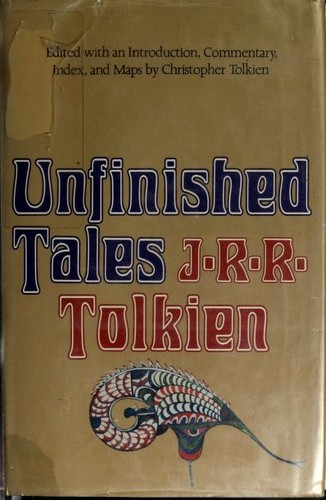
This is the natural next step, full stop. Published in 1980, again edited by Christopher Tolkien, it collects narratives his father never finished polishing: a much fuller version of the tale of Turin, the story of Aldarion and Erendis (the only real glimpse of life in Numenor at its height), the history of Galadriel and Celeborn, how Gandalf came to send Bilbo on the quest of Erebor, the origins of the Istari, and an account of the disaster at the Gladden Fields where Isildur fell. For Silmarillion readers, it answers questions the 1977 book only gestures at.
The honest caveat is in the title: these tales are unfinished, presented with Christopher Tolkien's editorial commentary, variant versions, and footnotes about contradictions between drafts. Some readers find that apparatus fascinating, a look inside the workshop; others find it constantly breaks the spell. If you want polished narrative, this will frustrate you in places. If The Silmarillion left you wanting the archive itself, this is the gateway, and the twelve-volume History of Middle-earth waits beyond it.
Read this if you want the genuine medieval mythology Tolkien's invented one imitates.
Tolkien set out to build a mythology with the texture of the real ones, and the Mabinogion, the great collection of medieval Welsh tales, is among the traditions he knew and drew on (Sindarin, the main Elvish tongue of The Silmarillion, is modeled on Welsh). Reading it, you recognize the register immediately: otherworld kingdoms, magical and disastrous oaths, enchanted objects, doomed heroes, and stories like Culhwch and Olwen, where winning a bride requires a list of impossible tasks, that feel like cousins of Beren and Luthien.
The difference is that nobody designed this for coherence. These are eleven anonymous tales written down in the twelfth to fourteenth centuries from older oral tradition, and they carry the strangeness of genuine myth: abrupt logic, unexplained magic, no tidy cosmology binding it all. Jeffrey Gantz's Penguin translation is clear and readable, and Sioned Davies's Oxford version is a good alternative. Pick this when you want to see the deep soil Tolkien grew his legendarium from, and accept that real myth is wilder than invented myth.
Read this for British myth woven into stories that actually move.
Susan Cooper's five-book sequence (1965 to 1977) does something Silmarillion readers tend to love: it treats the mythology of Britain, Arthurian legend, Welsh tradition, the Wild Hunt, Herne the Hunter, as a living force with deep time behind it. The long war between the Light and the Dark stretches back centuries, old things sleep under the landscape of Cornwall and Wales, and the books carry a real sense that the present is only the surface of an ancient story, which is exactly the feeling The Silmarillion gives The Lord of the Rings.
The form is completely different. These are children's novels, swift and atmospheric, centered on Will Stanton, a boy who learns on his eleventh birthday that he is the last of the Old Ones. There is no archaic prose and no invented cosmology to study; the mythic weight comes through mood rather than chronicle. Adults reread these constantly, especially the second book, The Dark Is Rising, a midwinter story with a serious cult following. Pick this when you want myth-soaked Britain in an evening-readable form, or a gift for a younger Tolkien reader.
Read this if The Silmarillion's archaic grandeur was a feature, not a bug.
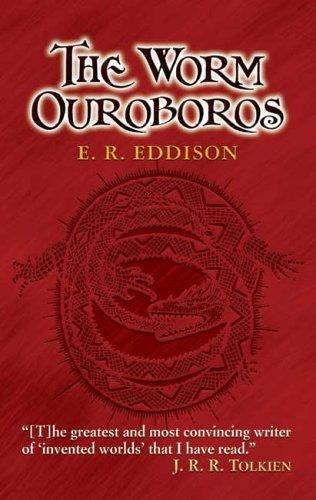
E.R. Eddison's 1922 epic is the book most often named alongside Tolkien when readers ask for pre-Tolkien high fantasy, and Tolkien himself read Eddison and praised him as a writer, even while disliking his philosophy. The war between Demonland and Witchland is told in deliberately Jacobean prose, dense, ornate, studded with archaisms, and the scale is fully mythic: impossible mountain ascents, sorcerous kings, heroes who exist for glory and great deeds. If you relished sentences in The Silmarillion that sounded carved rather than written, Eddison gives you an entire book at that pitch and beyond.
Be honest with yourself about the difficulty: the language is harder than Tolkien's, the opening framing device (a traveler transported from Earth) is clumsy and gets silently dropped, and Eddison's amoral aristocratic heroes, who love war for its own sake, are the opposite of Tolkien's moral universe. There are no hobbits here, nothing humble to hold onto. It rewards readers who treat the prose itself as the adventure, and the famous circular ending is one of fantasy's great audacities.
Read this if you want a feuding dynasty over true creation, told at thriller speed.
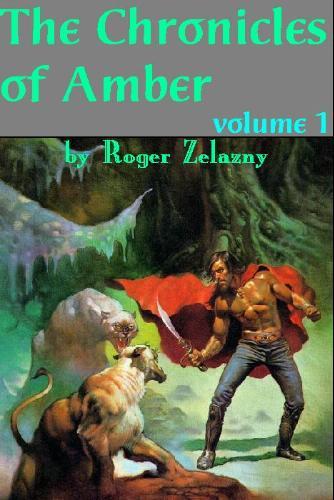
What Zelazny's series (ten short novels, beginning with Nine Princes in Amber in 1970) shares with The Silmarillion is its core situation: a single true world, Amber, of which all other worlds including our Earth are mere shadows, and a brilliant, proud royal family tearing itself apart over the succession. The princes of Amber scheme, betray, and war across realities, and the family dynamics, gifted siblings ruined by pride and rivalry, will remind Silmarillion readers strongly of the feuding sons of Feanor and the doom that follows them.
The execution could not be more different. Zelazny writes first-person, wisecracking, hardboiled prose; Corwin narrates like a noir detective, and the first book opens with amnesia in a modern hospital. There is no elevated register, no mythic distance, and the metaphysics is pulp-fast rather than scriptural. That makes it the easiest read on this list and the right pick when you want Silmarillion themes, dynasty, pride, exile, contested creation, without Silmarillion prose. The first five books form a complete story; opinions split on the second five.
Read this for myth-grade prose in a short, perfect novel.
Ursula K. Le Guin built Earthsea the way Tolkien built Middle-earth: from language outward. Magic here is the knowledge of true names, the old speech of dragons in which things cannot be lied about, and the novel's spare, cadenced prose has a gravity closer to legend than to standard fantasy. The story of Ged, a gifted young wizard whose pride looses a shadow on the world that he must finally turn and face, reads like a myth that always existed, which is precisely the effect The Silmarillion labors across hundreds of pages to achieve.
The difference is concentration. Where Tolkien gives you a whole legendarium, ages, genealogies, wars, Le Guin gives you one coming-of-age told in under 200 pages, intimate rather than panoramic, and her Taoist-inflected worldview (balance and shadow rather than a war of good against evil) runs against Tolkien's grain in interesting ways. It is the best-written book on this list by most measures. Read it in a sitting, then continue to The Tombs of Atuan and The Farthest Shore, which complete the original trilogy.
What should I read after The Silmarillion if I want more Middle-earth?
Unfinished Tales of Numenor and Middle-earth is the direct next step, with fuller versions of stories The Silmarillion compresses. After that, the standalone editions Christopher Tolkien prepared, The Children of Hurin, Beren and Luthien, and The Fall of Gondolin, present the three great tales in depth, and the twelve-volume History of Middle-earth covers the entire manuscript history for completists.
What non-Tolkien book is most like The Silmarillion?
The Worm Ouroboros by E.R. Eddison is the usual answer: a pre-Tolkien epic with archaic, elevated prose and a fully mythic scale, written in 1922 and admired by Tolkien himself. For invented myth in a more readable form, A Wizard of Earthsea comes closest in gravity per page, and the Mabinogion offers the real medieval tradition Tolkien's style imitates.
Is The Silmarillion harder to read than The Lord of the Rings?
Yes, and deliberately so. It is a compressed mythology rather than a novel: there is no single protagonist, the prose imitates biblical and saga style, and hundreds of names arrive quickly. Many readers find it easier on a second attempt, using the index and family trees, or after reading The Children of Hurin, which tells one of its central stories in conventional novel form.
Which book on this list is the easiest entry point?
The Chronicles of Amber reads fastest, with short books and a wisecracking first-person narrator, and A Wizard of Earthsea is a single short novel of exceptional quality. The Dark Is Rising Sequence is also quick, written for younger readers but widely loved by adults. Save The Worm Ouroboros for last; its Jacobean prose is the steepest climb here, steeper than The Silmarillion itself.
As an Amazon Associate, we earn from qualifying purchases. · About & methodology