6 books like Discworld, from Good Omens to The Hitchhiker's Guide to the Galaxy: comic fantasy and satire for Terry Pratchett readers wondering what's next.
Updated June 10, 2026
Terry Pratchett's Discworld is 41 novels deep, and what holds it together is not the flat world on four elephants on a turtle, charming as that is. It is the voice: footnotes that earn their interruptions, jokes that turn out to be arguments, and satire aimed at everything from Hollywood and the postal service to death, war, and belief. Pratchett started out parodying fantasy and ended up using it as a lens on humanity, with characters (Granny Weatherwax, Sam Vimes, Death himself) who are genuinely loved rather than merely funny. That combination is close to unrepeatable, which is the honest problem this list tries to solve.
The books below are sorted by which part of Discworld you are actually missing. If it is Pratchett's own voice, Good Omens (co-written with Neil Gaiman) and The Colour of Magic (the first Discworld novel, for anyone who started mid-series) are the direct routes. If it is the comedy of ideas, Douglas Adams's The Hitchhiker's Guide to the Galaxy and Jasper Fforde's The Eyre Affair run on similar absurdist wit. If it is myth and invention with a darker tone, Neil Gaiman's American Gods and Erin Morgenstern's The Night Circus trade the jokes for atmosphere.
One practical note: nobody on this list is as funny as Pratchett at his peak, and the last two picks are not trying to be funny at all. Read the hooks below and choose by what you want carried over, the laughs, the satire, or the worldbuilding, because no single book carries all three.
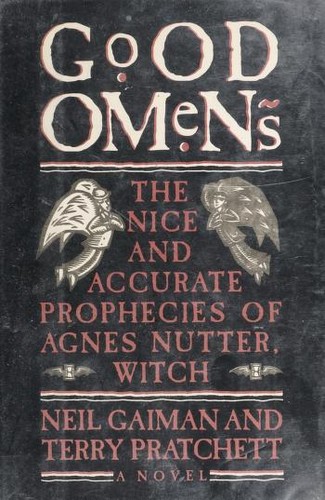
Read this first: it is half Pratchett, and it shows on every page.
This is the only book on the list that Terry Pratchett actually wrote, in collaboration with Neil Gaiman in 1990, and it is the closest thing to a Discworld novel set on Earth. The angel Aziraphale and the demon Crowley, who have gone comfortably native over six millennia, team up to derail the apocalypse after the Antichrist is misplaced in an English village. The footnotes, the affectionate skewering of bureaucracy (heavenly and infernal), and the underlying warmth about ordinary human muddle are pure Pratchett.
The differences are mostly Gaiman's: a slightly darker mythic streak and a contemporary-England setting instead of Ankh-Morpork. It is also a single standalone story, so it ends, which after a 41-book series can feel either like a relief or a loss. If you finish it wanting to know who wrote which bits, the authors themselves claimed to have lost track. The 2019 TV adaptation is a faithful bonus, but the book is funnier.
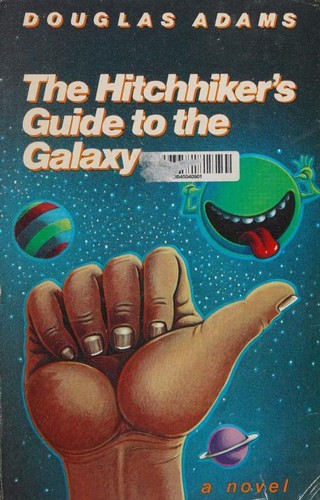
Read this if Pratchett's jokes mattered more to you than his fantasy.
Douglas Adams is the other great name in British comic genre fiction, and the comparison with Pratchett is the standard one for a reason. Hitchhiker's does for science fiction what early Discworld did for fantasy: it takes the furniture of the genre (spaceships, aliens, galactic civilizations) and uses it to satirize bureaucracy, philosophy, and the general indignity of existence. Arthur Dent, dragged off Earth in his dressing gown moments before the planet is demolished for a hyperspace bypass, is a very Pratchett-like ordinary man adrift in absurdity.
The difference is temperature. Adams is colder and more nihilistic; his universe is hilariously indifferent, where Pratchett's, for all its satire, fundamentally believes people can be decent. Adams also cared less about plot, and the five-book series visibly runs on set pieces and ideas rather than character arcs. If you loved Granny Weatherwax or Vimes as people, you may find Hitchhiker's brilliant but unmoored. If you loved the footnotes and the one-liners, this is the closest match in print.
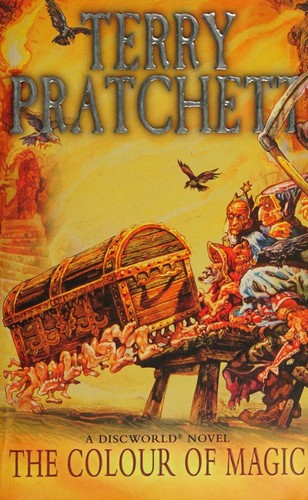
Read this if you came to Discworld sideways and want to start at the beginning.
This is where Discworld began in 1983: the failed wizard Rincewind is saddled with Twoflower, the Disc's first tourist, and chaos tours the world's geography and fantasy's clichés simultaneously. If you arrived at Pratchett through the TV adaptations, Good Omens, or a later novel handed to you out of order, this is the front door, and it introduces the turtle, the elephants, Ankh-Morpork, and Death (WHO TALKS LIKE THIS) in their original forms.
Honesty is required here: most longtime fans agree the first two books are the weakest in the series. The Colour of Magic is a parody of sword-and-sorcery rather than the humane satire Pratchett grew into, the plot is a string of episodes, and it ends on a literal cliffhanger resolved in The Light Fantastic. Many readers are better served starting with Guards! Guards! or Mort and circling back. But if you are a completist, or you want to watch a great writer find his voice in real time, start here.
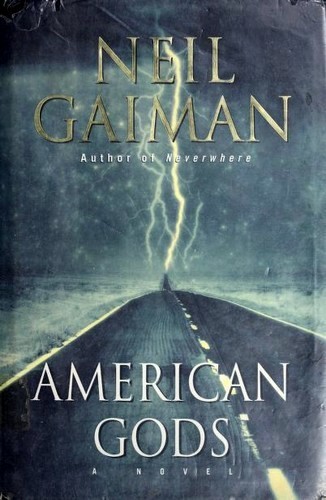
Read this if Small Gods was your favorite Discworld and you can do without the jokes.
Neil Gaiman was Pratchett's friend and collaborator, and American Gods works the same thematic ground as Discworld books like Small Gods and Hogfather: gods exist because people believe in them, and they fade when belief moves on. An ex-convict called Shadow is hired by the mysterious Mr. Wednesday and pulled into a brewing war between the old gods immigrants carried to America and the new gods of media, technology, and money. The mythological invention, gods scraping by as grifters and morticians in the American Midwest, has real Pratchett DNA.
But this is not a comic novel. It is slow, moody, sometimes violent and explicit, a road-trip Americana epic rather than a satire, and the wit surfaces in flashes rather than on every page. Readers who come to it expecting Good Omens's tone are regularly thrown. Pick it up when you want Pratchett's ideas about belief and myth treated with darker seriousness, and give it a hundred pages to settle in. It won the Hugo and Nebula awards, and earned them.
Read this only if it was Discworld's enchantment you loved, not its comedy.
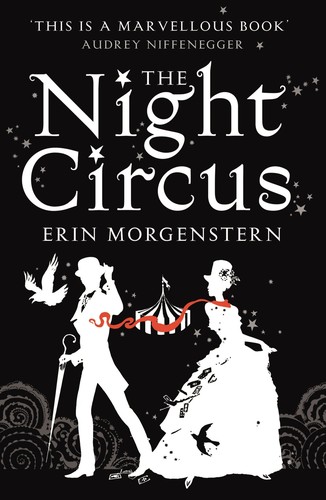
What The Night Circus shares with Discworld is the pleasure of a fully imagined magical place. Erin Morgenstern's circus arrives without warning, opens only at night, and contains tents of impossible wonders, an ice garden, a cloud maze, all of it the arena for a decades-long contest between two young illusionists bound to a game neither chose. Like Ankh-Morpork or the Unseen University, the setting itself is the star, rendered with the kind of detail that makes readers want to live there.
Everything else is different. There is no satire and almost no humor; the tone is romantic, dreamy, and deliberately slow, with lush description doing the work that jokes and plot do in Pratchett. The structure jumps across timelines, and readers who need momentum sometimes stall. This is the pick for the Discworld reader whose favorite moments were atmosphere and invention rather than wit, or for sharing with someone who bounces off comic fantasy entirely.
Read this if you want Pratchett-style absurdity aimed at literature itself.
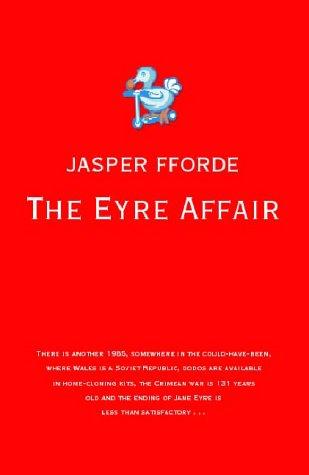
Jasper Fforde is the working writer most often recommended to bereft Pratchett fans, and The Eyre Affair shows why. In an alternate 1985 England where literature is a matter of national obsession and Special Operations jurisdiction, literary detective Thursday Next pursues a villain who is kidnapping characters out of novels, climaxing inside Jane Eyre itself. The density of jokes, puns, and throwaway invention (dodos as pets, militant Baconians door-knocking like missionaries) is the closest any living writer gets to Pratchett's comic excess.
The flavor is different, though: Fforde's absurdism is more surreal and gag-driven, closer to Monty Python crossed with a detective novel, and he lacks Pratchett's moral seriousness, the way a Discworld book is secretly about anger at injustice. You also get more out of it the more classic literature you have read, since much of the comedy is literary in-joke. Start here and, if it clicks, there are seven more Thursday Next books waiting.
What is the closest thing to reading more Terry Pratchett?
Good Omens, which Pratchett co-wrote with Neil Gaiman, is the only way to get actual new-to-you Pratchett prose outside Discworld's 41 novels. Beyond that, his non-Discworld work is worth knowing: the Long Earth series with Stephen Baxter, the Johnny Maxwell and Bromeliad trilogies for younger readers, and the standalone Nation, which Pratchett himself considered among his best books.
Which author is most similar to Terry Pratchett?
Douglas Adams is the standard comparison for the jokes and the satirical use of genre, and Jasper Fforde is the closest living writer in sheer comic invention. Neil Gaiman shares Pratchett's interests in myth and belief but with a much darker, less comic tone. Nobody fully combines Pratchett's humor with his warmth and moral anger, which is why he keeps selling.
Where should a new reader actually start Discworld?
Most fans steer newcomers away from publication order. Guards! Guards! (the City Watch books), Mort (the Death books), and Wyrd Sisters (the Witches books) are the usual recommended entry points, since the series found its mature voice around its fourth to eighth books. The Colour of Magic is the chronological start and worth reading eventually, but it is a broader parody than what the series became.
Is American Gods funny like Discworld?
No, and it is the most common mismatch on lists like this. American Gods shares Pratchett's fascination with gods sustained by human belief, an idea Discworld explores in Small Gods and Hogfather, but it is a slow, dark, atmospheric novel with only occasional flashes of wit. Read it for the mythology, not the comedy; for laughs, Good Omens or The Hitchhiker's Guide to the Galaxy are the right picks.
As an Amazon Associate, we earn from qualifying purchases. · About & methodology