7 books like Life 3.0 by Max Tegmark, from Superintelligence to Human Compatible: the best reads on AI's future, risks, and how the technology actually works.
Updated June 10, 2026
Max Tegmark's Life 3.0 stands out among AI books for its scope. A physicist by training, Tegmark is less interested in this decade's chatbots than in the full sweep of what intelligence becoming software could mean: consciousness, cosmic futures, and a dozen scenarios for how humanity and machine intelligence might coexist, from benevolent dictator AI to enslaved god. The opening fiction about the Omega team quietly taking over the world with a hidden AI is the part most readers remember, and the book's real achievement is making thousand-year questions feel like practical ones. It is speculative by design, and it wears that openly.
Readers who finish it tend to want one of three things. Some want the harder-edged argument about existential risk that Tegmark gestures at, which is where Superintelligence, Human Compatible, and Our Final Invention live. Some want to understand the actual technology underneath the speculation, served by The Master Algorithm, AI: A Very Short Introduction, and, for the genuinely committed, Sutton and Barto's Reinforcement Learning. And some want more far-future scenario building, which The Age of Em delivers in stranger and more rigorous form than almost anything else in print.
A practical note on ordering: Superintelligence and Human Compatible are the natural next reads and pair well, one philosophical and one from inside the field. Save The Age of Em for when you have a taste for dense speculation, and treat Reinforcement Learning as a textbook, because that is exactly what it is.
Our Top Picks
Best overall next read
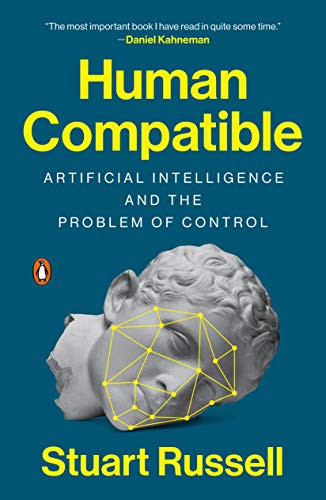
Human Compatible: Artificial Intelligence and the Problem of Control
Read this if Life 3.0's risk scenarios were the part you could not put down.
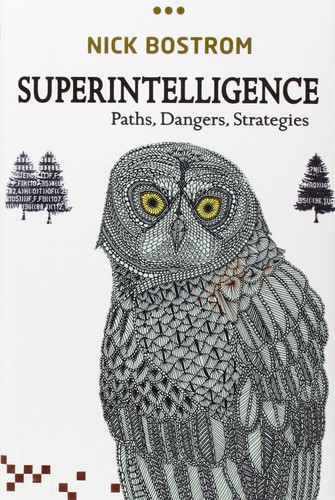
Nick Bostrom's 2014 book is the intellectual ancestor of Life 3.0, and Tegmark engages with it directly. Bostrom, an Oxford philosopher, works through the paths by which machine intelligence could surpass human intelligence and why controlling something smarter than us is harder than it sounds. The core ideas Tegmark popularizes, including the orthogonality of intelligence and goals and the danger of a fast takeoff, are laid out here with far more rigor. This is the book that convinced people like Elon Musk and Bill Gates to take AI risk seriously.
The trade-off is readability. Bostrom writes like the analytic philosopher he is, with taxonomies, careful qualifications, and thought experiments stacked on thought experiments, where Tegmark writes like a popularizer. There is none of Life 3.0's narrative warmth or cosmic optimism. Pick this if you want the argument at full strength and are willing to work for it; readers who found Tegmark's scenario chapters too breezy will find this the satisfying version.
Human Compatible: Artificial Intelligence and the Problem of Control
by Stuart Russell
Read this for the alignment problem explained by someone who builds AI for a living.
Stuart Russell co-wrote the standard university textbook on artificial intelligence, so when he argues that the field's basic design template is dangerous, it carries a different weight than a philosopher or physicist saying the same. Human Compatible covers much of Life 3.0's territory, what happens when machines pursue objectives better than we can, but grounds it in how AI systems are actually built. His proposed fix, machines that remain uncertain about human preferences and defer to us, is the most concrete solution offered in any book on this list.
It is narrower and more disciplined than Life 3.0. Russell does not speculate about consciousness or cosmic endowments; he stays close to the engineering question of control and answers it like an engineer. The prose is dry-witted and clear, and the book is shorter than it looks. If you read only one follow-up to Tegmark, this is the one, because it converts his open question (what future do we want?) into a tractable research agenda.
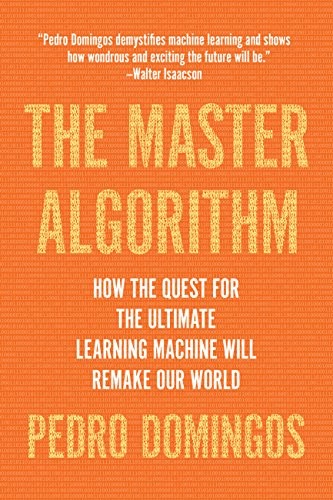
Read this if you want to understand the machine learning underneath the speculation.
Tegmark talks about what intelligent machines might do; Pedro Domingos explains how they learn. The Master Algorithm tours the five schools of machine learning (symbolists, connectionists, evolutionaries, Bayesians, and analogizers) and argues they are converging toward a single universal learner. For Life 3.0 readers who kept wondering what is actually inside these systems, this is the most accessible serious answer, written by a University of Washington professor who has worked in the field for decades.
Where Tegmark is cautious and risk-focused, Domingos is an enthusiast, and the book is notably sunnier about where machine learning is taking us. It also predates the large language model era, so its examples feel dated in places even though the underlying ideas hold up. Pick it for mechanism rather than ethics. Readers who want both should read it alongside Human Compatible, which supplies the worry Domingos mostly declines to share.
Read this if you want the alarm bell version with journalistic storytelling.
James Barrat is a documentary filmmaker, not a researcher, and Our Final Invention is built from interviews with AI scientists and risk thinkers including Eliezer Yudkowsky and the researchers around the early AI safety community. It covers the same core fear as Life 3.0's darker scenarios, an intelligence explosion we cannot steer, but with a reporter's instinct for character and anecdote rather than a physicist's taxonomies. Published in 2013, it was one of the first books to bring the existential risk argument to a general audience.
It is also the most one-sided book here. Barrat is openly trying to scare you, counterarguments get less airtime than they deserve, and some of the technical framing has aged. Read it as a fast, vivid case for the prosecution rather than a balanced survey. If Tegmark's even-handed scenario weighing left you wanting someone to just say what they think, Barrat says it loudly.
The Age of Em: Work, Love, and Life when Robots Rule the Earth
by Robin Hanson
Read this if Life 3.0's future scenarios were too brief for you.
Robin Hanson takes one of the futures Tegmark sketches, a world of brain emulations, and spends an entire book working out its economics, social structure, and daily life with deadpan thoroughness. Ems run at different speeds, copy themselves for work, and live in dense cities under economic dynamics Hanson derives step by step. Where Life 3.0 offers a dozen scenarios at a chapter's depth each, The Age of Em offers one scenario at book depth, and it is the most detailed piece of futurism most readers will ever encounter.
Be warned that it is a strange reading experience. Hanson, an economist, writes in flat declarative analysis with almost no narrative and little hand-holding, and he conspicuously refuses to say whether the world he describes is good or bad. Some readers find it brilliant; others find it unreadable. Pick it up if you want speculation treated as a serious analytical exercise, and skip it if what you liked about Tegmark was the accessible storytelling.
Read this only if you want to move from reading about AI to studying it.
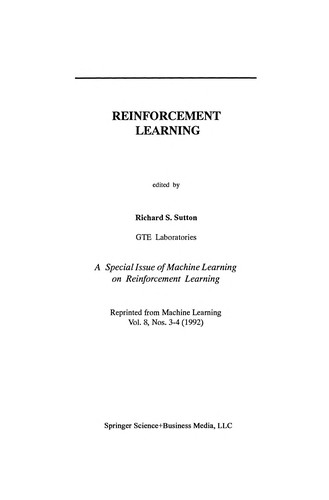
Sutton and Barto wrote the standard text on reinforcement learning, the branch of machine learning behind systems like AlphaGo that learn by trial, error, and reward. It connects to Life 3.0 at the conceptual root: Tegmark's whole discussion of machines pursuing goals is, technically speaking, a discussion of reward-driven agents, and this book is where that machinery is actually defined. The second edition is freely available online from the authors, which makes sampling it easy.
Make no mistake, this is a textbook, with equations, algorithms, and exercises, not a popular science book, and it assumes comfort with college-level math. It belongs on this list for the minority of Life 3.0 readers whose reaction was wanting to work on this stuff rather than just read about it. If that is you, this is the canonical starting point. Everyone else should choose Domingos or Boden instead.
Superintelligence by Nick Bostrom is the closest in subject, and Tegmark cites it directly; both work through how advanced AI could reshape or end human civilization. Human Compatible by Stuart Russell covers the same control problem in a more readable and more technically grounded way, and many readers consider it the better single follow-up.
Should I read Superintelligence or Life 3.0 first?
Life 3.0 first. Tegmark is the easier and broader read, and it gives you the landscape of scenarios and the vocabulary. Superintelligence then deepens the risk argument with much more philosophical rigor. Reading them in the other order works but makes Tegmark feel like a recap.
Is Life 3.0 still worth reading now that large language models exist?
Mostly yes. The book came out in 2017, before ChatGPT, so its examples and near-term predictions feel dated. But its core material, the scenarios for advanced AI, the discussion of goals and control, and the questions about consciousness, was always aimed past any particular technology and holds up. Pair it with Human Compatible for a more current view from inside the field.
Which of these books is best if I am new to AI?
AI: A Very Short Introduction by Margaret Boden. It is around 150 small pages, covers the field's history and main ideas, and is deliberately hype-free. The Master Algorithm is the next step up if you want a fuller picture of how machine learning works.
As an Amazon Associate, we earn from qualifying purchases. · About & methodology