7 books like Ghost in the Shell, from Akira and Battle Angel Alita to Snow Crash and Altered Carbon: cyberpunk manga and novels about minds, machines, and identity.
Updated June 10, 2026
Masamune Shirow's Ghost in the Shell, serialized starting in 1989, did something most cyberpunk never managed: it took the genre's hardware obsession and pointed it inward. Major Motoko Kusanagi is a full-body cyborg whose only original part may be her ghost, the consciousness inside the shell, and the manga keeps asking what identity means once memory can be edited and minds can be copied. Shirow surrounds the philosophy with dense police procedural plotting, political intrigue, and famously exhaustive margin notes about his own technology. It is a work you can read for the action or annotate like a textbook.
What you want next depends on which layer hooked you. If it was the manga tradition itself, Japanese science fiction comics with serious ideas and serious draftsmanship, go to Akira, Battle Angel Alita, or the Evangelion spinoff The Shinji Ikari Raising Project. If it was the cyberpunk philosophy, minds in networks and consciousness as data, the prose novels Snow Crash, Altered Carbon, and William Gibson's The Peripheral carry that thread. And if it was the dystopian media-saturated society around the Major, Transmetropolitan attacks that target harder than anything else in comics.
One practical note: the manga and the celebrated 1995 Mamoru Oshii film are quite different in tone, the manga looser and stranger, the film colder and more philosophical. The recommendations below lean toward the manga's mix, but every entry says which sensibility it serves, so match them to the version of Ghost in the Shell you actually love.
Read this if you want the other towering classic of serious science fiction manga.
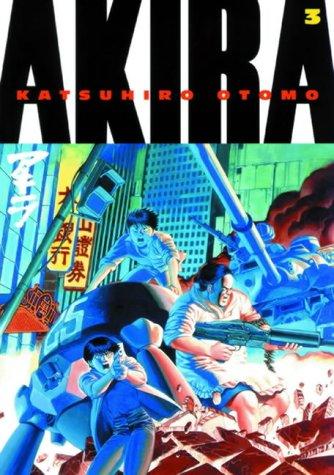
Katsuhiro Otomo's Akira is the book most often shelved next to Ghost in the Shell, and the pairing is fair. Both are landmark seinen manga from the same era that proved comics could carry novel-scale science fiction, both are set in a rebuilt future Tokyo (Neo-Tokyo here), and both were adapted into anime films that defined the medium internationally. Kaneda, Tetsuo, and the psychic children at the story's center drive a plot about government secrecy and power spiraling beyond control, drawn with a precision and urban detail that still looks ahead of its time.
The difference is where the speculation points. Shirow asks what technology does to the self; Otomo is interested in raw power, the body horror of Tetsuo's transformation, and a city tearing itself apart, with much less philosophical dialogue and much more kinetic destruction. It is also long, six thick volumes. Pick it when you want spectacle and momentum over cyberbrain theory; it is the most purely propulsive reading experience on this list.
Read this for another cyborg woman piecing together who she is.
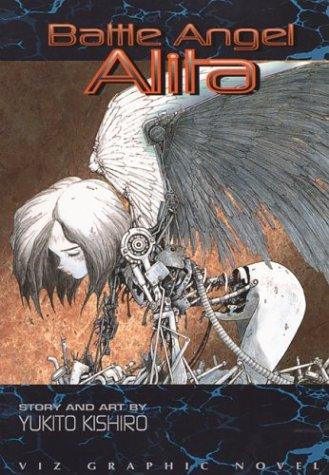
Yukito Kishiro's series is the closest manga companion to Ghost in the Shell. Alita is a cyborg salvaged from a scrapheap beneath the floating city Zalem, with no memory of her past and a combat instinct that keeps surfacing, and the series uses her search for identity to ask the same question Shirow asks through the Major: how much of a person survives when the body is replaceable? The Scrapyard setting gives it a grittier, street-level texture than Section 9's government corridors, with bounty hunters, cyborg sports, and a brutal class divide between the surface and the city above.
Kishiro is more of an action storyteller and less of a systems thinker than Shirow; you get fewer essays on technology and more tournament arcs and emotional melodrama, and the philosophy arrives through Alita's relationships rather than dialogue about networks. That makes it the more accessible read of the two. Choose it if you connected with Kusanagi as a character, not just as a concept, and want a longer journey with someone like her.
Neon Genesis Evangelion: The Shinji Ikari Raising Project
by Osamu Takahashi
Read this only if you want the Evangelion universe in a deliberately lighter key.
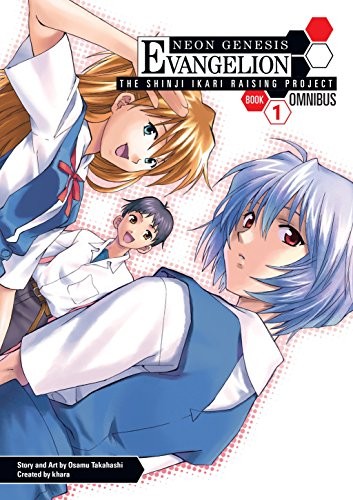
Evangelion belongs in any conversation about Ghost in the Shell: both franchises define the serious end of Japanese science fiction, both fuse human minds with machines, and both put psychology where most mecha and cyborg stories put hardware. This spinoff manga by Osamu Takahashi transplants Shinji, Rei, and Asuka into an alternate, gentler timeline, keeping the characters and the NERV setting while dialing the apocalyptic dread far down in favor of school-life comedy and romance.
Be clear about what it is: a long-running comedic alternate-universe series, not the bleak original. If you have never read Evangelion, start with Yoshiyuki Sadamoto's main manga adaptation instead, which carries the psychological weight that earns the Ghost in the Shell comparison. This version suits readers who already know the franchise and want time with its characters minus the trauma. As a follow-up to Shirow's philosophical density, it is the lightest pick here by a wide margin.
Read this if the dystopian city interested you more than the cyborgs.
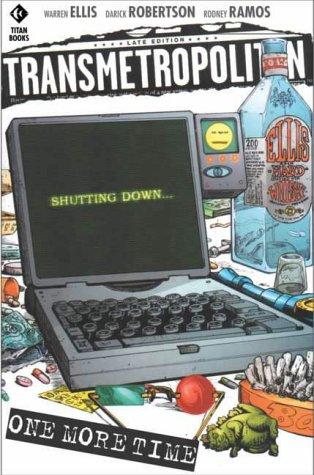
Warren Ellis and artist Darick Robertson built Transmetropolitan around Spider Jerusalem, a gonzo journalist in a future City drowning in technology, advertising, body modification, and political rot. It shares Ghost in the Shell's conviction that the future's real story is institutional: where Section 9 fights corruption from inside the state, Spider attacks it from outside with a bowel disruptor and a column deadline. The world-building density rivals Shirow's, every panel crammed with transient species, religions invented overnight, and media noise.
The register is completely different, though. This is satire, profane and furious and very funny, with politics modeled on American press wars rather than Japanese bureaucracy, and it cares little for the consciousness questions at Shirow's core. It is also a Western comic, so the visual grammar shifts. Pick it when you want cyberpunk's social rage rather than its metaphysics, and be ready for a protagonist who is gleefully unpleasant in a way the Major never is.
Read this for cyberpunk's founding author working with bodies as remote shells.
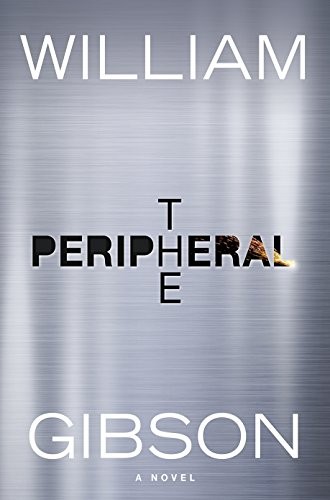
William Gibson coined cyberspace and built the genre Ghost in the Shell grew up inside, and The Peripheral is his late-career return to full science fiction. Its central device is strikingly Shirow-like: Flynne, a woman in a near-future rural America, ends up operating a peripheral, an artificial body in a London seventy years ahead, her consciousness piloting a shell across time. The questions about presence, embodiment, and what counts as being somewhere are the Major's questions, asked in prose by the writer who started the conversation.
Gibson demands more patience than Shirow. He explains almost nothing up front, alternates two timelines, and buries the plot mechanics in oblique dialogue, so the first hundred pages are work. There is also no action-procedural rhythm; the thrills are slow and structural. Choose it if you want the literary end of these ideas, or start with his classic Neuromancer if you have somehow skipped it. Readers who only wanted the gunfights should pick Altered Carbon instead.
Read this if you want cyberpunk's ideas delivered at full satirical speed.
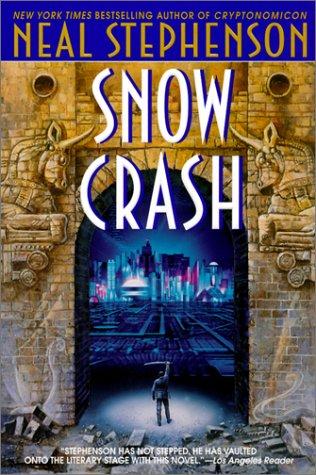
Neal Stephenson's 1992 novel is the prose book that shares the most DNA with Ghost in the Shell's world: a privatized near-future, a virtual Metaverse layered over reality, and a plot about information itself as a weapon, here a virus that can crash human minds the way code crashes computers. Hiro Protagonist, hacker and swordsman, and the skateboard courier Y.T. chase that virus through franchise-nation America. The idea that minds are hackable systems is the same wager Shirow makes with ghost-hacking, played for velocity instead of melancholy.
Stephenson is louder and jokier than Shirow ever gets; the book opens with a pizza delivery treated like a military operation, and the satire stays at that pitch. It also pauses for long Sumerian mythology lectures that readers either relish or skim. Pick it when you want the network-age philosophy with the throttle open. It is the most fun entry point to prose cyberpunk on this list.
Read this for bodies as disposable hardware in a hard-boiled package.
Richard K. Morgan's debut takes Ghost in the Shell's premise to its logical extreme: in his future, consciousness lives in a cortical stack and bodies are sleeves, swapped, rented, and destroyed, so death is mostly an inconvenience for the rich. Takeshi Kovacs, a former elite soldier downloaded into a stranger's body to solve a murder, navigates exactly the questions Shirow raises about what identity means when the shell is interchangeable, inside a noir detective plot that keeps the pages turning.
Where the manga treats these ideas with a certain analytic cool, Morgan goes brutal: the violence is graphic, the sex is explicit, and the tone is cynical hard-boiled rather than philosophical procedural. The thinking is real but arrives between gunfights, not instead of them. Choose it if Section 9's operations were your favorite chapters and you want noir momentum; readers primarily there for the philosophy will find The Peripheral the more contemplative pick.
What should I read after the Ghost in the Shell manga?
For manga, Battle Angel Alita is the closest match, another cyborg woman investigating her own identity, with Akira as the other essential classic. For prose, Snow Crash and Altered Carbon carry the minds-as-data ideas forward, and William Gibson's Neuromancer is the genre's foundation if you have not read it. Shirow's own sequels, Ghost in the Shell 1.5 and 2: Man-Machine Interface, also exist, though 2 is famously dense and divisive.
Is the Ghost in the Shell manga different from the 1995 movie?
Substantially. Shirow's manga mixes its philosophy with humor, action, and long technical margin notes, and the Major is a more irreverent character. Mamoru Oshii's film strips that down into something slower, colder, and more meditative. Stories and characters overlap, but the tones are distinct enough that fans of one are sometimes lukewarm on the other.
Which book here is most like Ghost in the Shell's philosophy of identity?
Altered Carbon engages the body-swapping question most directly, with consciousness stored in stacks and moved between sleeves. The Peripheral is the more literary take, with minds piloting remote artificial bodies. Among the manga, Battle Angel Alita comes closest, building its whole story on a cyborg's search for who she was.
Do I need to know Evangelion before reading The Shinji Ikari Raising Project?
It helps a lot. The Raising Project is a lighter alternate-universe comedy that assumes familiarity with the characters. If you are new to Evangelion, read Yoshiyuki Sadamoto's main Neon Genesis Evangelion manga first; it is the version whose psychological depth genuinely parallels Ghost in the Shell.
As an Amazon Associate, we earn from qualifying purchases. · About & methodology