Books Like Cryptography and Network Security: Principles and Practice
Explore books on cryptography, network security, secure systems, and practical cybersecurity after Cryptography and Network Security.
Updated June 11, 2026
William Stallings' Cryptography and Network Security: Principles and Practice is the textbook a generation of computer science students met cryptography through. Its strength is breadth with discipline: it walks from classical ciphers through AES, RSA, elliptic curves, and hash functions, then keeps going into the protocols that actually use them, TLS, IPsec, Kerberos, email security. Stallings writes survey textbooks for a living, and it shows in the even pacing and the steady supply of diagrams and end-of-chapter problems. What it is not is deep in any one direction, which is usually why people go looking for the next book.
The list below is sorted by which direction you want that depth. If you want more mathematical rigor, Stinson's Cryptography: Theory and Practice and Trappe and Washington's Introduction to Cryptography with Coding Theory go further into the proofs and number theory Stallings only samples. If you want the systems and protocol side, Kaufman, Perlman, and Speciner's Network Security and Schneier's Applied Cryptography are the classics, and Security in Computing and Stallings' own Computer Security widen the lens to the whole security field. If you want the story rather than the syllabus, Simon Singh's The Code Book is the one to read on a couch instead of at a desk.
A practical note: several of these are older books, and in cryptography age matters. Schneier's Applied Cryptography dates to the mid-1990s and predates AES, so treat it as a foundation and a reference, not a guide to what to deploy today. For current algorithm choices, recent editions of the textbooks here are the safer source.
Our Top Picks
Best overall next read
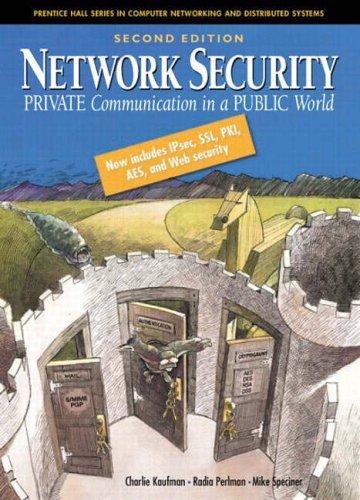
Network Security: Private Communication in a Public World
by Charlie Kaufman, Radia Perlman, and Mike Speciner
Books to Read If You Like Cryptography and Network Security: Principles and Practice
Applied Cryptography: Protocols, Algorithms, and Source Code in C
by Bruce Schneier
Read this for the legendary practitioner's encyclopedia of protocols and algorithms.
Bruce Schneier's Applied Cryptography is probably the most famous cryptography book ever written for working programmers, and it complements Stallings exactly where Stallings is thin: protocols. Beyond the standard algorithms, Schneier catalogs the building blocks of applied cryptography, key exchange, digital signatures, secret splitting, zero-knowledge proofs, secure elections, digital cash, with C source code and a plainspoken voice that made the field feel approachable to a generation of engineers in a way no textbook did.
The caveat is its age. The second edition is from 1996, before AES, before modern TLS, before authenticated encryption became standard practice, and Schneier himself has said the book made implementation look easier than it is (his later Cryptography Engineering, with Ferguson and Kohno, is the corrective). Read it as a brilliant survey of ideas and a historical landmark, and pair it with something current before you build anything. For breadth of cryptographic imagination, nothing else on this list matches it.
Read this if you want the history and human drama instead of another textbook.
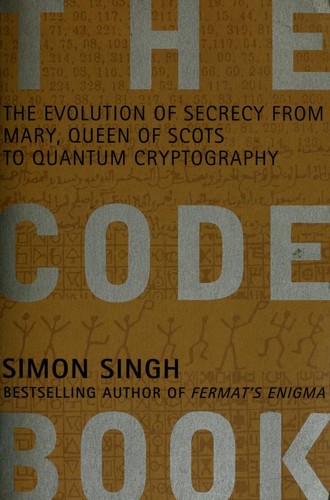
Simon Singh's The Code Book is the one entry here you can hand to anyone. It tells cryptography's story through its great contests: Mary Queen of Scots undone by a broken cipher, the Vigenère cipher cracked by Babbage, Enigma against Bletchley Park, the birth of public-key cryptography, and a closing look at quantum cryptography. For a Stallings reader, the payoff is context. The algorithms you studied as chapter exercises appear here as inventions with stakes, personalities, and consequences.
It differs from everything else on this list in carrying no technical prerequisites and offering no implementation detail; the math is sketched at popular-science level, and it was published in 1999, so the modern era is thin. That is fine, because its job is different. Read it for pleasure, or give it to someone who wonders why you find this field interesting. If you already know the history of Enigma and Diffie-Hellman well, you can skip it without loss.
Read this if you want the rigorous mathematics Stallings only samples.
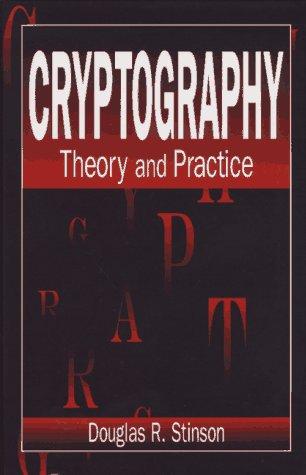
Douglas Stinson's textbook (later editions with Maura Paterson) is the standard next step up in rigor. Where Stallings describes how algorithms work, Stinson proves things: perfect secrecy and Shannon theory, the number theory behind RSA and discrete logarithms, security definitions and reductions, the analysis of hash functions and signature schemes. If you came out of Stallings able to follow AES's steps but unable to say precisely what makes a scheme secure, this book closes that gap.
The difference in audience is real. Stinson assumes comfort with proofs and undergraduate algebra and probability, covers essentially no network protocols, and reads like a mathematics text because it is one. It is the right pick for students heading toward graduate work or anyone who wants cryptography as a mathematical discipline rather than an engineering toolkit. If your interest is deploying and operating secure systems, Kaufman, Perlman, and Speciner will serve you better.
Network Security: Private Communication in a Public World
by Charlie Kaufman, Radia Perlman, and Mike Speciner
Read this for the protocol side, explained with more wit and insight than any textbook.
Kaufman, Perlman, and Speciner's book covers much of the same ground as the back half of Stallings, authentication, key distribution, Kerberos, PKI, IPsec, TLS, email security, but with a completely different voice. The authors are protocol designers (Radia Perlman invented spanning tree), and they explain not just how each protocol works but why it was designed that way and where the design is awkward, with dry humor that makes a famously tedious subject genuinely readable. Many security engineers name it as the book that made protocols click.
Compared to Stallings, it is lighter on the cryptographic algorithms themselves, you will not find AES internals worked through, and editions are spaced far apart (the third edition arrived in 2022, decades after the second), so check that you are getting the current one. Choose it if the systems and protocol chapters of Stallings were the ones you cared about; it is the strongest single follow-up on this list for working network and security engineers.
Read this for a math-first treatment that stays friendlier than Stinson.
Trappe and Washington's textbook occupies a useful middle rung between Stallings and Stinson. It treats cryptography as applied mathematics, with real chapters on the number theory behind RSA, discrete logarithms, and elliptic curves, plus material most cryptography texts skip entirely: error-correcting codes, lattice methods, and quantum techniques. It also includes computer examples in Mathematica, Maple, and MATLAB (with Sage in later editions), which makes the math hands-on in a way pure theory books are not.
It is a course textbook rather than a reference, organized for a semester of mathematical cryptography, and it has little to say about network protocols or systems security; nobody learns TLS from Trappe and Washington. Pick it if Stinson looks intimidating but you know you want more mathematics than Stallings gave you, especially if the coding theory connection interests you. Engineers focused on practice can pass over it without guilt.
by Charles P. Pfleeger and Shari Lawrence Pfleeger
Read this if you want the whole security field, with cryptography as one chapter among many.
The Pfleegers' Security in Computing is a broad survey of computer security as a discipline: software vulnerabilities, operating system and database security, malware, network defenses, privacy, risk management, and legal and ethical issues, with cryptography presented as a tool inside that bigger picture. For a Stallings reader, it answers the question his book deliberately brackets, namely everything that goes wrong outside the cryptographic layer, which in practice is where most breaches actually happen.
The trade-off is the mirror image of the rest of this list: its cryptography coverage is shallower than anything else here, so you would read it to widen rather than deepen. It is also a large, sober textbook, more reference than page-turner, and editions vary in currency (recent ones added cloud and IoT material). Choose it if you are building toward a general security role or certification; skip it if cryptography specifically is what you want more of.
Read this if you want Stallings' own companion volume on the rest of security.
This is Stallings again, writing with Lawrie Brown, and it is the official sibling of the cryptography book: same style, same pedagogy, same diagram-heavy survey approach, applied to the rest of the field. Authentication and access control, malware, denial of service, intrusion detection, firewalls, software and OS security, and security management all get the methodical Stallings treatment, with the cryptographic material compressed since the other book covers it. If his approach worked for you, this is the lowest-friction way to cover the remaining ground, and it maps cleanly onto standard security curricula.
The weakness is the same as the strength: it is more of the same. You get breadth and order, not the designer's insight of Kaufman, Perlman, and Speciner or the depth of Stinson, and survey textbooks in security age quickly between editions. Pick it if you are studying for coursework or want one organized reference beside the cryptography volume; pick Security in Computing instead if you would rather hear the broad story in a different voice.
What is the best book to read after Stallings' Cryptography and Network Security?
It depends on which half of the book you liked. For the protocol and systems half, Network Security: Private Communication in a Public World by Kaufman, Perlman, and Speciner is the standout follow-up. For the algorithms and math half, Stinson's Cryptography: Theory and Practice adds the rigor Stallings omits. If you want one enjoyable non-textbook, read Simon Singh's The Code Book.
Is Applied Cryptography by Bruce Schneier still worth reading?
Yes, with eyes open. It remains an unmatched survey of cryptographic protocols and ideas, but the 1996 second edition predates AES and modern TLS, and Schneier himself later co-wrote Cryptography Engineering partly to correct the impression that implementing cryptography is easy. Read it for concepts and breadth, and rely on a current textbook for what to actually use today.
Which of these books is the most mathematical?
Stinson's Cryptography: Theory and Practice is the most rigorous, with formal definitions and proofs throughout, and it assumes comfort with undergraduate algebra and probability. Trappe and Washington's Introduction to Cryptography with Coding Theory is a gentler math-first option with computational examples. Stallings, by comparison, presents the mathematics descriptively without demanding proof-level work.
Do I need to read these in a particular order?
No. They split into tracks rather than a sequence. A theory track runs Stallings, then Trappe and Washington, then Stinson. A practice track runs Stallings, then Kaufman, Perlman, and Speciner, then a broad text like Security in Computing or Stallings and Brown's Computer Security. The Code Book and Applied Cryptography can be read at any point for context and breadth.
As an Amazon Associate, we earn from qualifying purchases. · About & methodology