Explore accessible books about capitalism, economics, markets, inequality, and political economy after Capitalism: A Very Short Introduction.
Updated June 11, 2026
James Fulcher's Capitalism: A Very Short Introduction does what the best entries in Oxford's Very Short Introduction series do: it compresses a sprawling subject into about 150 pages without dumbing it down. Fulcher traces capitalism from seventeenth-century merchant ventures through industrial production to today's financialized global economy, and he is careful to present capitalism as a system with distinct national varieties and recurring crises rather than a single fixed thing. It is a primer, but an unusually balanced one, neither a celebration nor a polemic.
The natural problem with finishing a Very Short Introduction is that it is, by design, an appetizer. The books below are organized around the three directions readers usually want to go next. If you want the foundations, there is Adam Smith's The Wealth of Nations, the text every later argument answers to. If you want the big contemporary debates, Piketty's Capital in the Twenty-First Century and Acemoglu and Robinson's Why Nations Fail tackle inequality and why some nations prosper. And if you want the critiques Fulcher only gestures at, Naomi Klein's The Shock Doctrine and Arundhati Roy's Capitalism: A Ghost Story make the case for the prosecution.
A practical note on difficulty: these range widely. Frieden's Global Capitalism and Why Nations Fail are accessible to anyone who got through Fulcher. The Wealth of Nations and Piketty are long and demand patience, though both are less technical than their reputations suggest. Pick by appetite, not by fame.
Our Top Picks
Best overall next read
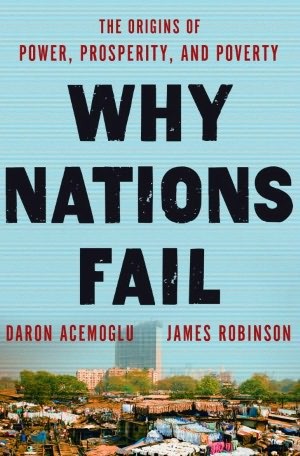
Why Nations Fail: The Origins of Power, Prosperity, and Poverty
Read this if you want the source document behind everything Fulcher summarizes.
Adam Smith's 1776 treatise is where the modern study of capitalism begins, and Fulcher's historical chapters lean on ideas Smith articulated first: the division of labor, markets coordinating self-interested behavior, and the conditions under which commerce makes nations richer. Reading Smith directly is a different experience from reading about him. The famous invisible hand appears only briefly, and much of the book is Smith the careful observer, working through pin factories, grain prices, and colonial trade with a skepticism about merchants and monopolies that surprises readers who know him only as a free-market mascot.
The honest warning is length and age. This is an eighteenth-century book that runs roughly a thousand pages depending on edition, and the prose, while clear, is leisurely. Most readers do well with an abridged edition or by focusing on Books I and IV. Pick this if you want to engage with the foundational arguments yourself rather than receive them secondhand; skip it for now if you mainly want to understand capitalism as it operates today.
Read this if the question that stuck with you was who actually benefits.
Thomas Piketty's 2013 bestseller is the most influential economics book of its generation, and it picks up the thread Fulcher's later chapters open: what happens to wealth and income distribution as capitalism matures. Piketty assembles two centuries of tax and inheritance data across France, Britain, the United States, and elsewhere to argue that when the return on capital outpaces economic growth, wealth concentrates, and that the relatively equal mid-twentieth century was an exception driven by wars and policy, not a natural tendency of the system.
It differs from Fulcher in scale and ambition: around 700 pages, built on data rather than narrative history, with a concrete policy proposal (a global wealth tax) that has been argued over ever since. It is more readable than its size suggests, with literary references from Balzac and Austen used to illustrate inherited wealth. Choose it if you want one serious, evidence-heavy argument to wrestle with. Critics dispute parts of the data and the theory, which is part of why it is worth reading.
The Shock Doctrine: The Rise of Disaster Capitalism
by Naomi Klein
Read this if you want the strongest popular critique of free-market policy in practice.
Naomi Klein's 2007 book covers territory Fulcher treats briefly, the spread of free-market reforms across the globe since the 1970s, but from a sharply critical angle. Her thesis is that radical privatization and deregulation have repeatedly been pushed through in moments of crisis, when populations are too disoriented to resist, with case studies running from Pinochet's Chile through post-Soviet Russia to post-Katrina New Orleans and occupied Iraq. As a tour of late twentieth-century economic history it is vivid and genuinely informative.
Be clear about what you are getting: this is advocacy journalism with a thesis, not a balanced survey, and economists across the spectrum have disputed both specific claims and the framing. Where Fulcher presents debates, Klein prosecutes a case. That makes it a useful counterweight rather than a replacement, and it pairs well with Frieden's more even-handed Global Capitalism. Pick it if Fulcher left you wanting passion and narrative; approach its conclusions as arguments to test, not settled history.
Read this for a view of capitalism from India rather than the West.
Arundhati Roy's slim essay collection shares with Fulcher's book its brevity and its interest in capitalism as a lived system rather than an abstraction, but it relocates the story to contemporary India. Roy, the Booker Prize-winning novelist turned essayist, writes about the gap between India's billionaires and its dispossessed, the role of corporate philanthropy and NGOs, and the conflicts over land and minerals in central India. Most overviews of capitalism are written from London or New York; this is a corrective to that vantage point.
It is also the most polemical book on this list, angrier than Klein and with no pretense of weighing both sides. Some readers find Roy's rhetoric bracing and her ground-level detail invaluable; others find the argument too sweeping. At well under 200 pages it is a quick read, so the cost of finding out is low. Choose it if you want a non-Western, literary, openly political perspective to set against the survey histories; skip it if you are looking for economic analysis in the conventional sense.
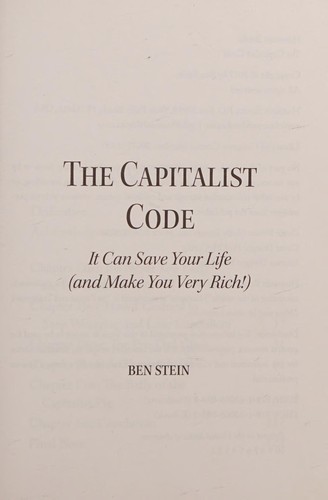
Read this only if you want a short personal-finance pep talk, not analysis.
Ben Stein's short 2017 book connects to Fulcher's subject from the most practical possible angle: instead of asking what capitalism is, it asks how an ordinary person can use it. Stein's core advice is simple and repeated, become an owner rather than only a worker by buying broad index funds early and letting compounding work. As a gentle introduction to why owning a slice of the corporate economy has historically built wealth, it is painless and can be read in an evening.
It is by far the lightest book here, and readers coming from Fulcher should know it contains no history, no debate, and no engagement with capitalism's critics; it is cheerful financial self-help from a conservative commentator. If your interest is intellectual, skip it. If finishing Fulcher left you thinking about your own position inside the system and you want a first nudge toward investing, it does that job, though many readers will outgrow it quickly.
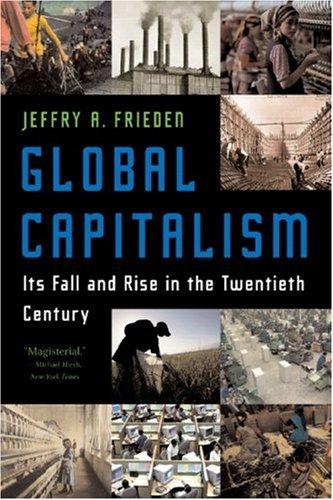
Global Capitalism: Its Fall and Rise in the Twentieth Century
by Jeffry A. Frieden
Read this if you want Fulcher's historical chapters expanded into a full narrative.
Jeffry Frieden's history is the most natural direct sequel on this list. Where Fulcher sketches capitalism's evolution in a few dozen pages, Frieden, a Harvard political economist, devotes a full book to the twentieth century: the first globalization before 1914, its collapse into depression and autarky between the wars, the managed Bretton Woods order after 1945, and the return of global markets from the 1970s on. The organizing insight, that global capitalism fell apart once and was deliberately rebuilt, gives the century a clear shape.
The difference from Fulcher is depth and steadiness rather than ideology; Frieden writes analytic narrative history, more detailed than a primer but without academic jargon. It is long, around 500 pages, and stronger on policy and international economics than on daily life. Choose it if your favorite parts of the Very Short Introduction were the historical ones and you want the full version of that story told carefully and without a polemical agenda.
Read this if the deep question for you is why capitalism works in some places and not others.
Daron Acemoglu and James Robinson ask the question lurking under Fulcher's whole book: why have some countries built prosperous market economies while others stay poor? Their answer is institutions. Inclusive political and economic institutions, which protect property rights and spread power, foster growth; extractive ones, designed to enrich an elite, choke it off. The argument is carried by a remarkable range of cases, from the two halves of the city of Nogales on the US-Mexico border to colonial history, the Glorious Revolution, and the Soviet Union. Acemoglu and Robinson later shared the 2024 Nobel in economics for work on these themes.
It is more argumentative than Fulcher's even-handed primer, hammering one thesis through every example, and critics say it underplays geography, culture, and the awkward case of China's growth under extractive politics. But it is accessible, concrete, and genuinely changes how you read the news. Of everything here, it is the most rewarding single next step for a reader who liked the Very Short Introduction's big-picture altitude.
James Fulcher, a sociologist who taught at the University of Leicester, wrote it for Oxford University Press's Very Short Introduction series. The first edition appeared in 2004 and it has since been updated. Like the rest of the series, it is a compact survey, roughly 150 pages, aimed at general readers rather than economists.
What should I read after Capitalism: A Very Short Introduction?
It depends on direction. For history, Jeffry Frieden's Global Capitalism expands Fulcher's historical sketch into a full account of the twentieth century. For the big contemporary debates, Piketty's Capital in the Twenty-First Century covers inequality and Why Nations Fail covers why prosperity varies. For critique, Naomi Klein's The Shock Doctrine is the standard popular indictment of free-market reform.
Is The Wealth of Nations too hard for a general reader?
Not too hard, but it is long. Smith writes clearly by eighteenth-century standards, and there is no mathematics, but the full text runs around a thousand pages with long digressions on grain prices and colonial trade. Most general readers are better served by a good abridged edition or by reading Books I and IV, which contain the core arguments about the division of labor, markets, and trade.
Which of these books is most critical of capitalism, and which most favorable?
Arundhati Roy's Capitalism: A Ghost Story is the most hostile, an openly polemical set of essays, with Klein's The Shock Doctrine close behind. Ben Stein's The Capitalist Code is the most enthusiastic, treating capitalism as a wealth-building tool for ordinary people. Fulcher, Frieden, Piketty, and Acemoglu and Robinson all sit between, analyzing the system's strengths and failures rather than cheering or condemning it.
As an Amazon Associate, we earn from qualifying purchases. · About & methodology