5 books like Bowling Alone by Robert Putnam, from The Lonely American to Reclaiming Conversation: community decline, loneliness, and what rebuilds connection.
Updated June 10, 2026
Robert D. Putnam's Bowling Alone (2000) made an academic concept, social capital, into a national conversation, and it did it with data. Putnam documented the decline of American civic life across decades of survey evidence: falling membership in clubs and churches, fewer dinner parties, less voting, and the title image of Americans bowling more than ever but in leagues less than ever. The book's argument is that these connections are not just pleasant but load-bearing, tied to health, safety, education, and democracy itself. It is long and chart-heavy, and that rigor is exactly why it stuck.
Readers who finish it tend to want one of three things, and this list covers all of them. Some want the personal and psychological side of the same story, what disconnection does to individual lives, which is where The Lonely American delivers. Some want the modern sequel Putnam could not write in 2000, the smartphone chapter, which Sherry Turkle's Reclaiming Conversation provides. And some want to move from diagnosis to repair, which is the explicit project of Peter Block's Community: The Structure of Belonging. The Great American Disconnect and The Social Life of Information round out the political and informational angles.
A practical note: none of these matches Putnam's sheer empirical heft, and most are shorter and more readable for it. If you skimmed Bowling Alone's appendices, you will find these faster company. If the data was the point for you, Turkle and Olds and Schwartz are the most evidence-grounded picks here.
Our Top Picks
Best overall next read
The Lonely American: Drifting Apart in the 21st Century
Read this if you want Putnam's civic decline traced into politics and democratic dysfunction.
Jed Morey's book takes the same basic worry that animates Bowling Alone, that Americans have come unmoored from one another and from shared civic life, and pushes it toward its political consequences. Where Putnam measures the fraying of community through bowling leagues and PTA rolls, Morey is concerned with what that fraying costs a democracy: the threats that accumulate when citizens disengage and institutions stop answering to anyone. The diagnosis rhymes with Putnam's even when the evidence and emphasis differ.
It is a more polemical and less academic book than Bowling Alone, written by a journalist and publisher rather than a Harvard political scientist, so expect argument and opinion where Putnam gives you regression tables. It is also far less famous, which cuts both ways: you will not find decades of scholarly debate around it, but you may find a more urgent, contemporary voice. Pick it if Bowling Alone left you more worried about democracy than about dinner parties.
Read this if you want to know what Putnam's statistics feel like from the inside.
Jacqueline Olds and Richard S. Schwartz, both psychiatrists at Harvard Medical School, cite Bowling Alone directly and write what amounts to its clinical companion. Where Putnam counts the empty seats at the Elks lodge, they sit with the people who stopped showing up, examining how busyness, self-reliance, and the American cult of independence lead people to drift away from friends and family almost without deciding to. The two books describe the same phenomenon at two altitudes, society-wide trend and individual life.
The difference is method and tone. This is a warmer, more intimate book built on case material and psychology rather than survey data, and it is more interested in marriage, friendship, and shame than in civic institutions. It also offers something Bowling Alone mostly does not: practical thinking about how individuals step back in from the edge. Pick it if the chapter of Putnam that stayed with you was the health evidence, the finding that isolation can be as damaging as smoking.
Read this for the chapter Bowling Alone could not include: what phones did next.
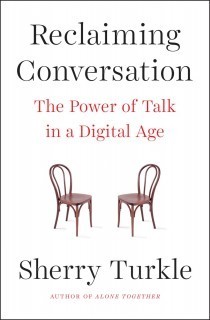
Bowling Alone was published in 2000, before smartphones and social media, and Putnam could only gesture at television and early internet as suspects in civic decline. Sherry Turkle, an MIT professor who has studied people and technology for decades, picks up exactly where he left off. Drawing on years of interviews with families, students, and coworkers, she argues that constant connectivity is hollowing out face-to-face conversation, the basic unit of the social capital Putnam prized, and with it empathy, solitude, and the capacity for real friendship.
Turkle is an ethnographer rather than a quantitative social scientist, so her evidence is interviews and observation instead of longitudinal surveys, and some readers find her more alarmed than the data strictly requires. She is also more hopeful than her reputation suggests: the book's argument is that conversation is recoverable, with concrete suggestions for reclaiming it at home and at work. This is the most natural next read for anyone who finished Bowling Alone wondering what Putnam would say about Instagram.
Read this if you are done diagnosing the problem and want to work on it.
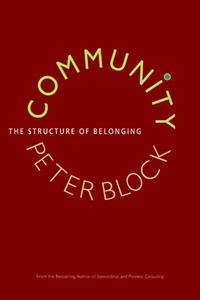
Peter Block takes Putnam's central concept, social capital, and treats it as a design problem. His question is not why community declined but how belonging actually gets built: through small groups, through the questions leaders ask, through how rooms are physically arranged and conversations structured. He engages directly with the social capital literature, including Putnam, and converts it into a practice for civic leaders, organizers, clergy, and anyone trying to knit a neighborhood back together.
Be aware that this is closer to an organizational and civic handbook than a work of social science, and Block's consulting-world style (frameworks, invitations, named types of conversation) reads as inspiring to some and abstract to others. There is little data here and a lot of conviction. It is the right pick if Bowling Alone persuaded you completely and your question is now what to do on Tuesday night, not whether the trend is real.
Read this if you want the argument that information cannot replace human networks.
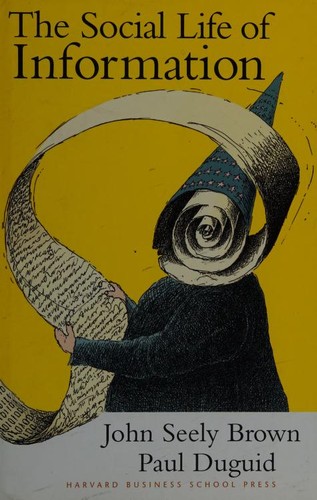
John Seely Brown and Paul Duguid, writing from Xerox PARC and UC Berkeley around the same moment Bowling Alone appeared, made a complementary case: that information and technology only work because they are embedded in human communities, practices, and institutions. Their famous examples, like office workers learning through stories around the copier rather than through manuals, are social capital operating inside organizations. It shares Putnam's deep skepticism of the idea that digital tools can simply substitute for human connection.
The lens is different, though. This is a book about work, knowledge, and the limits of 1990s techno-utopianism, not about bowling leagues or civic decline, and parts of it (critiques of the paperless office, software agents, distance learning hype) are now period pieces, interestingly so. Pick it if you read Bowling Alone as a book about institutions and want the workplace version, or if you want an early, smart rebuttal to the claim that the internet would make community obsolete.
The Lonely American by Jacqueline Olds and Richard S. Schwartz is the closest match in spirit: it documents the same American drift toward isolation, engages Putnam's findings directly, and adds the psychological dimension his survey data cannot reach. For the technology-era continuation of the argument, Sherry Turkle's Reclaiming Conversation is the strongest pick.
Did Robert Putnam write other books like Bowling Alone?
Yes. Our Kids: The American Dream in Crisis (2015) applies the same data-rich method to the opportunity gap facing American children, and The Upswing (2020, with Shaylyn Romney Garrett) traces how America moved from an individualist Gilded Age to a communitarian mid-century and back again. Better Together (2003, with Lewis Feldstein) collects case studies of communities rebuilding social capital.
Is Bowling Alone still relevant, given it came out in 2000?
Arguably more than ever. Putnam wrote before smartphones and social media, and the trends he documented, declining membership, fewer friendships, less civic participation, have largely continued or accelerated since. A 20th anniversary edition added new material on the digital era, and later books like Turkle's Reclaiming Conversation effectively extend his argument into the smartphone age.
What should I read about fixing the problem Bowling Alone describes?
Peter Block's Community: The Structure of Belonging is the most direct answer on this list, a practical framework for building belonging in neighborhoods and organizations. Putnam's own Better Together collects real examples of American communities that rebuilt social capital. Olds and Schwartz's The Lonely American also closes with concrete thinking about reconnecting at the individual level.
As an Amazon Associate, we earn from qualifying purchases. · About & methodology