4 books like Annihilation by Jeff VanderMeer: Blindsight, The Vorrh, House of Leaves, and more weird fiction about places and minds beyond comprehension.
Updated June 11, 2026
Annihilation is the rare horror-adjacent novel where the scariest thing is not a monster but a place. Area X, the abandoned coastline VanderMeer's nameless biologist is sent into, does not attack the twelfth expedition so much as rewrite it: a tower that should be a tunnel, words written in living fungus, a crawling something whose origin the book pointedly refuses to explain. The biologist's cold, observational voice (she is more moved by a starfish than by her own marriage) is half the effect. Readers finish it unsettled in a way most science fiction never manages, because the book withholds exactly the answers a normal novel would supply.
The four books below chase that feeling from different directions. Blindsight is the pick if what gripped you was the encounter with a genuinely alien intelligence that makes human consciousness look like the anomaly. The Vorrh is for the atmosphere, a vast sentient forest that warps everyone who enters, the closest thing here to another Area X. House of Leaves takes the impossible-space dread of the tower and builds an entire formal labyrinth out of it. Annihilation Aria shares a word of the title and an ecological streak but is a much lighter, pulpier ride, and the entry below is honest about that.
A practical note: none of these are comfort reads, and two of them (Blindsight and House of Leaves) ask real work of the reader. If what you actually want is more Area X, VanderMeer wrote it: Authority and Acceptance complete the Southern Reach trilogy, and Absolution returned to it in 2024. The books here are for when you have finished those and still want the world to feel wrong.
Read this if the best part of Annihilation was confronting something genuinely beyond human understanding.
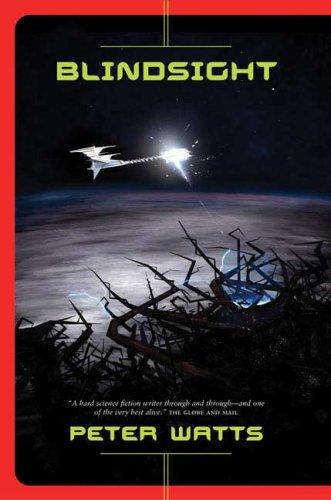
Peter Watts sends a crew of modified humans (a synthesist with half a brain, a linguist with surgically induced multiple personalities, a resurrected vampire as captain) to investigate an alien object at the edge of the solar system, and what they find is intelligence without consciousness, capability without anyone home. That is the same nerve Annihilation hits: an encounter that does not just threaten the characters but undermines their categories for what a mind, or a self, even is. Both books also use an emotionally flattened narrator whose detachment becomes part of the horror.
The difference is register. Watts is hard science fiction, dense with real neuroscience and game theory, and he argues his bleak thesis explicitly where VanderMeer keeps everything dreamlike and unresolved. It is a colder, more demanding book, with footnotes and references at the back. Pick it if you wanted Annihilation's ideas pushed to their logical end; skip it if the lush, fungal, Southern-Gothic texture was what you loved, because there is none of that in deep space.
Read this if Area X itself, the place that changes whoever enters, was what you could not shake.
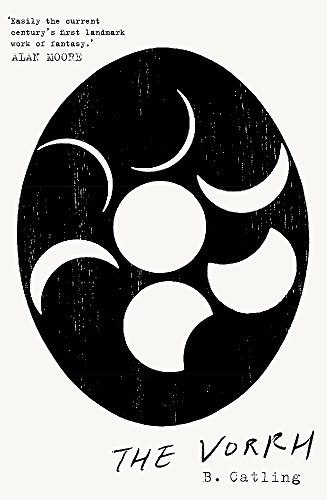
Brian Catling's Vorrh is the closest thing in modern fiction to another Area X: an immense, possibly eternal forest in colonial Africa that erases the memories of those who cross it, said to hold the Garden of Eden at its heart. Like VanderMeer, Catling (a sculptor and poet by training) builds dread out of vegetation, transformation, and the sense that the landscape has intentions humans cannot parse. VanderMeer himself championed the book and wrote the introduction to its US edition, which tells you how directly the two share DNA.
It is a wilder, less disciplined novel than Annihilation: a sprawling cast that includes a cyclops raised in a basement and the real photographer Eadweard Muybridge, a plot that braids and digresses, and prose that runs ornate where VanderMeer's biologist is clinical. There is no single tidy expedition structure to hold onto. Choose it if you want immersion and strangeness over momentum, and give it patience; it is the first of a trilogy.
Read this if the tower that should not exist was the moment Annihilation truly got you.
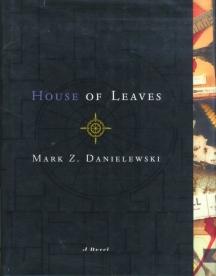
The heart of Mark Z. Danielewski's novel is a house that measures larger inside than outside, then opens a hallway into lightless, shifting space that should not be there. That is the dread of Annihilation's tower-tunnel expanded to book length: a spatial impossibility that the characters document, explore with expeditions, and are psychologically dismantled by. Both books are also obsessed with documentation itself, the biologist's field journal in one, the layered manuscripts and academic footnotes in the other, and with how recording the impossible fails to contain it.
House of Leaves is far more formally extreme. The text spirals, inverts, and dwindles to single words per page; the story is nested three narrators deep, and a strand follows a tattoo artist's unraveling in footnotes. Some readers find the apparatus exhilarating, others find it a gimmick stretched over 700 pages. It is horror about architecture and obsession rather than nature and biology. Pick it when you want a book that is itself a labyrinth, and read it in print, not as an ebook.
Read this only if you want the ecological ideas in a fun space opera, not another dose of dread.
Honesty first: Michael R. Underwood's novel shares a title word with VanderMeer's book and not much of its temperament. This is a space opera about a married couple, a human archaeologist and his galactic-songbird wife, dodging an empire while awakening ancient powers. Where it does connect is underneath the action: the book cares about ecosystems, about ancient forces that reshape worlds, and about the consequences of meddling with environments that operate on scales beyond the protagonists' understanding.
Everything else is opposite. The tone is warm and banter-driven, the couple actually like each other (a deliberate rarity in the genre), and mysteries here get answered rather than deepened. Nobody finishes this book unsettled. Pick it as a palate cleanser after the heavier titles above, or if Annihilation's bleakness was the part you did not enjoy. If you came for cosmic dread, choose Blindsight or House of Leaves instead.
Should I just read the rest of the Southern Reach series first?
Probably, yes. Authority and Acceptance complete the original trilogy, shifting from the expedition itself to the agency behind it and then to the origins of Area X, and Absolution (2024) returned to the setting with a prequel. Be warned that Authority is a slower, bureaucratic-paranoia novel that divides readers. The books on this list are best once you have decided how deep into VanderMeer you want to go.
What book is most similar to Annihilation?
From this list, The Vorrh is closest in feel: a vast, sentient wilderness that transforms whoever enters it, written with the same conviction that nature is stranger than any monster. Blindsight is closest in ideas, an encounter with an intelligence that breaks human frameworks. Outside this list, Roadside Picnic by the Strugatsky brothers is the classic forerunner; its alien Zone directly anticipates Area X.
Is Annihilation based on a true story or a real place?
No, but it has a real-world anchor. VanderMeer has said Area X grew out of his hikes in the St. Marks National Wildlife Refuge in northern Florida, whose wild coastline, lighthouse, and dense ecology are recognizable in the book. The plot, the expeditions, and the Southern Reach agency are entirely fictional.
How different is the Annihilation movie from the book?
Substantially. Alex Garland's 2018 film keeps the premise (an all-women expedition into a transforming zone) but invents its own imagery, including the shimmer and the bear that screams with a human voice, and gives the story a more conventional explanation and climax than the novel ever offers. Garland has said he adapted it from memory after one read. Fans of the book's ambiguity often prefer the book; fans of the film's visuals still have plenty left to discover in the trilogy.
As an Amazon Associate, we earn from qualifying purchases. · About & methodology